Open-label placebo · known sugar · IBS
Placebo still worked when they said it was sugar.
You wanted the labeled pills to move the gut score after the bottle already said placebo.
An open-label placebo is pills labeled placebo that people know are sugar. IBS is irritable bowel, a gut that hurts or cramps. IBS-GIS is a sheet that scores how the gut feels. IBS-SSS is another gut-symptom sheet. Adequate relief means they said the week was better. Avicel is the filler in the pill. No-treatment, also called no-bottle, means no pills for the same days. An arm here is one side of the study. The four-point script is the short talk they heard before they took the pills. d tells you how big the change was.
What is an open-label placebo?
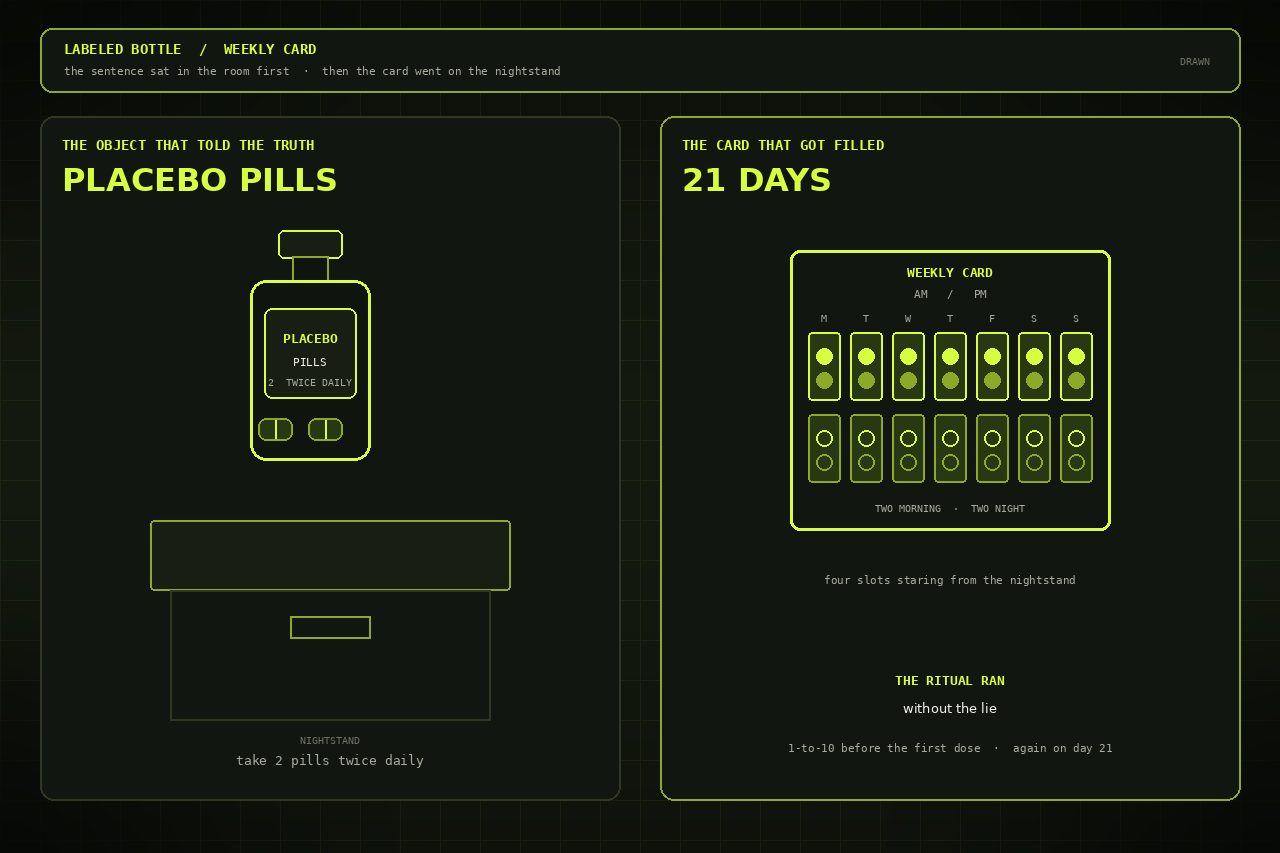
An open-label placebo is pills labeled placebo that people know are sugar, so people can read the word on the bottle and still take two pills twice a day.
People already do this when they want a labeled pill to help. You wanted the labeled pills to move the gut score after the bottle already said placebo, so keep the open-label name.
What is IBS?
IBS is irritable bowel, which means a gut that hurts or cramps, and people in this study already had that kind of gut pain.
You can still want the labeled pills to move the gut score if a hurting gut is why you came.
What is a no-bottle arm?
No-treatment, also called no-bottle, means no pills for the same days. An arm here is one side of the study. Those people still came to the same visits, and they just did not take a labeled pill.
The no-bottle side is a real comparison. People with no bottle still belong in this study, so keep them as the other side of the same 21 days.
Did placebo still work when they said it was sugar?
Kaptchuk, with Friedlander, Kelley, Sanchez, Kokkotou, Singer, Kowalczykowski, Miller, Kirsch, and Lembo, published this paper in 2010 in PLoS ONE. PLoS ONE is the journal. You can read the paper at doi.org/10.1371/journal.pone.0015591.
The title of the paper is “Placebos without Deception: A Randomized Controlled Trial in Irritable Bowel Syndrome.” It also carries DOI 10.1371/journal.pone.0015591 and PMID 21203519.
They enrolled 80 people. Thirty-seven people took open-label pills, and forty-three people got no bottle.
They got a bottle marked placebo pills and took two blue and maroon pills twice a day for 21 days. Avicel is the filler in those pills. Day 11 was the midpoint, which means they marked the gut sheet again in the middle of those days.
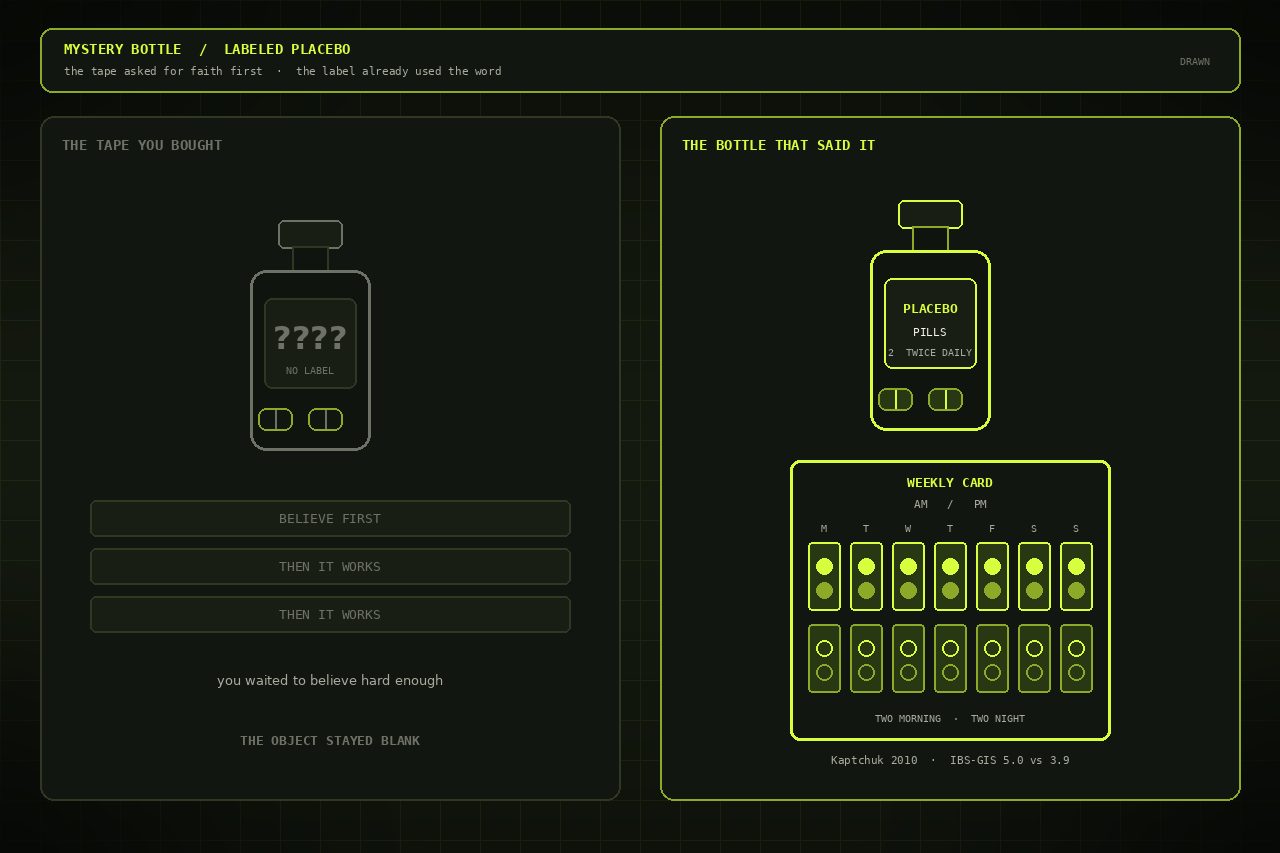
On day 21, people who took the labeled pills scored 5.0 on the gut sheet, and people with no bottle scored 3.9. That gap was p=.002, and d was 0.79. d tells you how big the change was. A p value tells you how often a gap this big would show up if the two sides were the same.
On day 11, people who took the labeled pills scored 5.2 after they already knew the pills were sugar, and people with no bottle scored 4.0.
Keep wanting the labeled pills to move the score.
What is IBS-GIS?
IBS-GIS is a sheet that scores how the gut feels. People mark how the gut felt that week, and a higher mark on that sheet means the gut felt better.
People who took the labeled pills marked 5.0 on that sheet. People with no bottle marked 3.9.
What did people hear before they took the pills?
The four-point script is the short talk they heard before they took the pills, and that talk lasted about 15 minutes.
They heard that placebo can be strong, and they heard that a body can answer a pill the way a dog answers a bell after the bell used to mean food. They also heard that a good mood helps, that they did not have to have one, and that taking the pills on time matters.
People with no bottle heard the same kind of visit. They just left without a bottle.
What is IBS-SSS?
IBS-SSS is another gut-symptom sheet. When that number goes down, the gut hurts less. On day 21, people who took the labeled pills dropped 92, and people with no bottle dropped 46. That gap was p=.03.
Adequate relief means they said the week was better. On day 21, 59 percent of people who took the labeled pills said the week was better, and 35 percent of people with no bottle said the same thing. That gap was p=.03.
People with no bottle still gave a real comparison. You can still want the labeled pills to move the score.
Can you still want labeled placebo pills?
You can still want a labeled pill to help. People already take pills they know are sugar when they want the labeled pills to move a gut score.
Keep the open-label name, and keep the no-bottle side as the other side of the same days.
If you feel unusual distress or you need care, talk to a clinician, because this page is educational and not a diagnosis or a treatment plan.
If you want a page about a line you say about yourself, open the affirmation page.
Can you still want the labeled pills to move the score?
You wanted the labeled pills to move the gut score after the bottle already said placebo. Keep the open-label name.
People who took pills labeled placebo scored 5.0 on the gut sheet, and people with no bottle scored 3.9. You can still want the labeled pills to move the score.
Sources
Kaptchuk T.J., Friedlander E., Kelley J.M., Sanchez M.N., Kokkotou E., Singer J.P., Kowalczykowski M., Miller F.G., Kirsch I., Lembo A.J. “Placebos without Deception: A Randomized Controlled Trial in Irritable Bowel Syndrome.” PLoS ONE 2010;5(12):e15591. DOI 10.1371/journal.pone.0015591. PMID 21203519. PMC 3008733. n=80 (37 open-label, 43 no-treatment). Label: placebo pills, take 2 twice daily. Blue and maroon Avicel. 21 days. Day 11 midpoint. Script ~15 min, four points. IBS-GIS day 21 5.0±1.5 vs 3.9±1.3, p=.002, d=0.79. Day 11 5.2 vs 4.0. IBS-SSS drop day 21 92±99 vs 46±74, p=.03. Adequate relief day 21 59% vs 35%, p=.03. doi.org/10.1371/journal.pone.0015591 · pubmed.ncbi.nlm.nih.gov/21203519 · pmc.ncbi.nlm.nih.gov/articles/PMC3008733