Memory reconsolidation · ten minutes · six hours
Ten minutes held the fear down. Six hours later it came back.
You said I am confident two hundred times. The old fear still sat in your chest.
Those lines were a real try. You said them in the car and again in the bathroom. When the old scene came back, you still felt the same fear.
After you bring an old memory back, the brain can rewrite it for a few hours. People call that rewrite memory reconsolidation. The window is those few hours.
Keep the cards if they help you stand up. The rewrite happens in those hours, after you bring the old scene back.
Name the old fear, then prove it wrong
Name the old fear once. A reminder is the cue that brings that memory back. Extinction is the lab word for the safe repeats after that reminder.
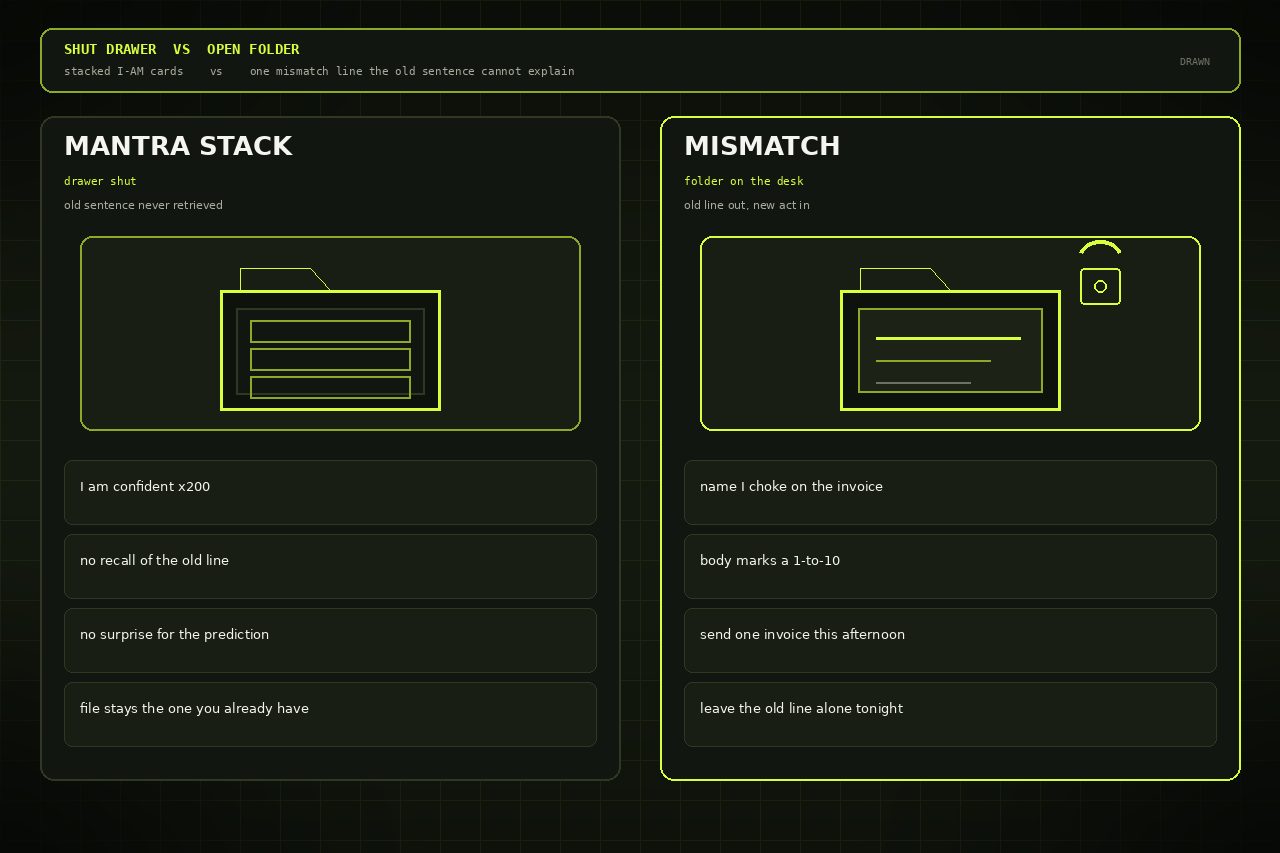
You pull the memory and live a mismatch on one clock. A mismatch is one act the old fear cannot explain. That is the rewrite.
They used the same unlearning on two clocks
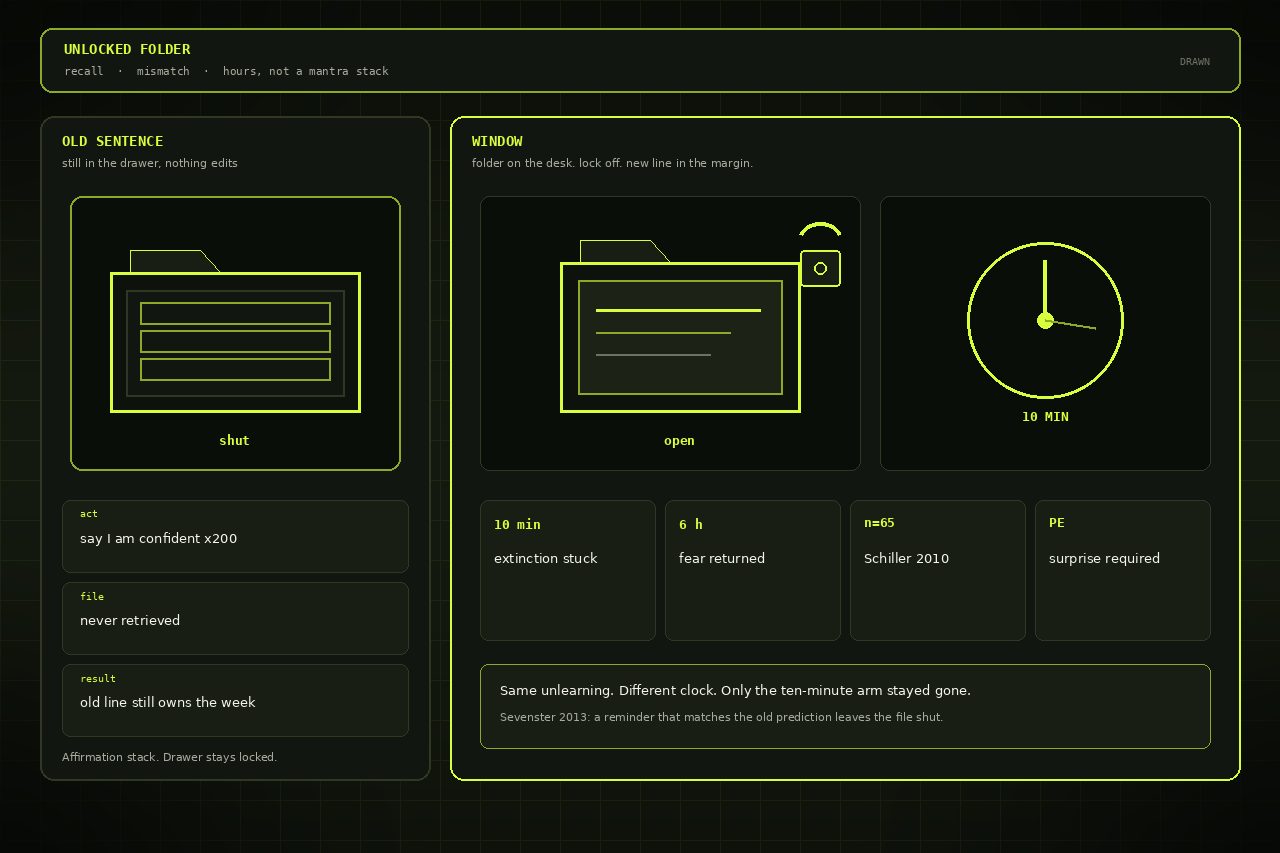
In 2010 Schiller's group put this in Nature. They taught people a fear, brought that fear back with one reminder, and then gave the same safe repeats on two clocks, ten minutes for one group and six hours for the other.
The ten-minute group kept the fear down. The six-hour group saw it return. A third group skipped the reminder, still got the safe repeats, and the fear came back there too.
They used the same unlearning on two clocks, and the two groups split on the wait.
Read the paper at doi.org/10.1038/nature08637 and at europepmc.org/article/MED/20010606.
If the reminder matches, you learn nothing
Sevenster's 2013 Science paper asked a sharper question. The reminder has to surprise you.
If the reminder matches what you already expected, people cannot rewrite the memory. The brain gets no surprise. The lab name for that surprise is prediction error. That means what happens does not match what you thought would happen.
People keep the memory closed when the reminder matches. You have to live something you did not expect.
The 2013 paper is at doi.org/10.1126/science.1231357.
The short wait left the fear area quieter
Agren's group ran the same ten-minute wait against the same six-hour wait. When people used the short wait, the fear area in the brain went quieter. That fear area is the amygdala. The amygdala is a small almond-shaped spot that flags threat.
That scan paper is at doi.org/10.1126/science.1223006.
Kindt's group gave people a pill after they brought the fear back. The pill without the recall did nothing. You have to bring the memory back first.
Kindt 2009 is at doi.org/10.1038/nn.2271.
Nader's rat work in 2000 named the protein step. The human story on this page is the ten-minute wait.
SATS is the drowsy hour
SATS is Neville's drowsy hour, the time before sleep when you loop a short scene as if it already happened. You plant a new scene in that hour. On this page you open an old memory while you are awake.
Keep SATS if that drowsy hour is yours. Open the SATS page for that drowsy loop.
People ask this after the first surprise
Do the I-am cards still count?
Yes. Keep them if they help you stand up. The cards were a reach. The rewrite happens in the hours after you bring the old scene back.
Does a matching reminder still rewrite the memory?
A reminder that matches what you expected leaves the memory closed. The reminder has to surprise you.
Do I run this as a trauma treatment?
This page teaches the lab clock. If you need care, talk to a clinician.
After dinner, bring the old scene back
The I-am line can stay on the card. You already said it two hundred times.
After dinner, bring the old scene back once. Live one thing it cannot explain. Then leave the rest of the day alone.
Sources
Schiller, Monfils, Raio, Johnson, LeDoux, Phelps, “Preventing the return of fear in humans using reconsolidation update mechanisms,” Nature 2010;463:49-53, DOI 10.1038/nature08637, PMID 20010606, Exp 1 10-min n=20, 6-h n=23, no-reminder n=22, 1-year remnant n=19 (8 vs 11), Exp 2 n=18. doi.org/10.1038/nature08637 · europepmc.org/article/MED/20010606
Sevenster 2013, Science 339:830-833, DOI 10.1126/science.1231357, PMID 23413355, 3 groups n=15, matching reminder teaches nothing, prediction error needed. doi.org/10.1126/science.1231357
Agren 2012, Science 337:1550-1552, DOI 10.1126/science.1223006, PMID 22997340, 30 recruited, 22 acquired, 10-min vs 6-h, amygdala quieter when the window was used. doi.org/10.1126/science.1223006
Kindt 2009, Nature Neuroscience 12:256-258, DOI 10.1038/nn.2271, PMID 19219038, n=20/20/20, propranolol 40 mg, pill without recall did nothing. doi.org/10.1038/nn.2271
Nader 2000, Nature 406:722-726, DOI 10.1038/35021052, PMID 10963596, rat protein synthesis, named once. doi.org/10.1038/35021052