EFT tapping · cortisol · talk hour
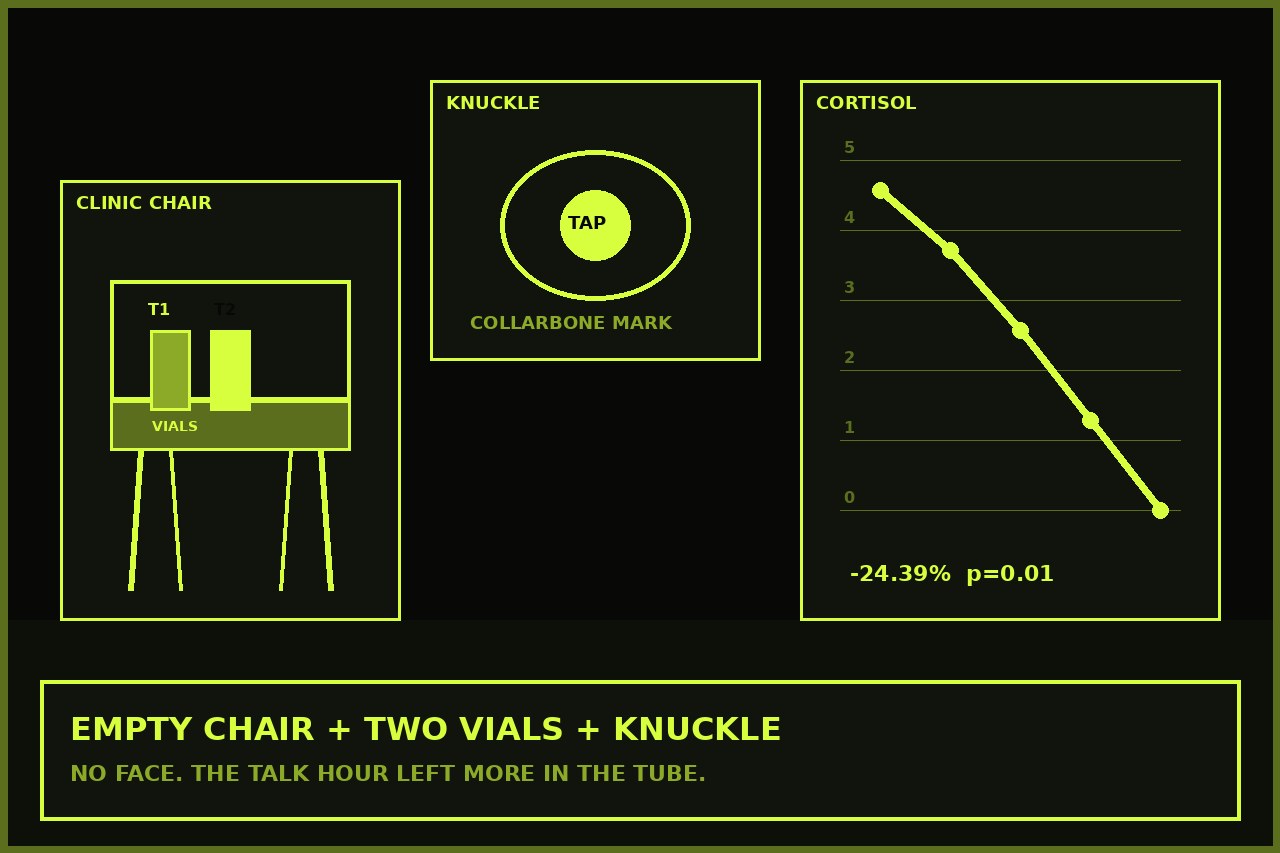
EFT tapping cut cortisol 24 percent.
You wanted the tapping to drop the stress hormone after a talk already had a chair.
EFT tapping is tapping on 12 body points while you hold a hard thought. People also call that Emotional Freedom Techniques. Cortisol is the stress hormone a spit test can see. A supportive interview, also called a talk hour, is 50 minutes with a licensed therapist talking through the same kind of thought. Church, Yount, and Brooks ran this work at five integrative clinics in California. Keep the EFT name.
What is EFT tapping?
EFT tapping is tapping on 12 body points while you hold a hard thought. People also call that Emotional Freedom Techniques. A certified life coach ran a 50-minute session from the Craig manual of 2008 and 2011. People tapped those 12 points in any order. You wanted that tapping to drop the stress hormone after a talk already had a chair. Keep the tapping.
What is cortisol?
Cortisol is the stress hormone a spit test can see. Your body makes it when you feel stress. Salivary means from spit. The team used a spit test from Sabre Sciences in Carlsbad, California. People gave a second spit sample 30 minutes after the hour.
What is a supportive interview?
A supportive interview, also called a talk hour, is 50 minutes with a licensed therapist talking through the same kind of thought. A licensed psychologist or a marriage and family therapist ran that hour. They used a CBT supportive interview. CBT here means they talked through the thought in a structured way. People who talked also dropped the stress hormone. Keep the talk hour too.
What is a wait room in this study?
A wait room is the group of people who waited, with no talk and no tap. The team still took their spit, so they could see what happened when nobody talked and nobody tapped.
Did EFT tapping cut cortisol?
Church, Yount, and Brooks published this paper in 2012. The journal is The Journal of Nervous and Mental Disease. They ran the work with the Foundation for Epigenetic Medicine in Fulton, California, the California Pacific Medical Center Research Institute, and the University of Arizona, at five integrative clinics in California. You can read the paper at doi.org/10.1097/NMD.0b013e31826b9fc1.
The title of the paper is “The Effect of Emotional Freedom Techniques on Stress Biochemistry: A Randomized Controlled Trial.” It also carries DOI 10.1097/NMD.0b013e31826b9fc1, PMID 22986277, and ClinicalTrials.gov NCT00641394.
One hundred three people applied. Fifteen people did not show. The team excluded four people for new trauma in the last 20 minutes, and they excluded one person for cortisol under 0.5 or over 6 ng/ml, which is how much of that hormone was in the spit. The final group was 83 people who were not a clinical patient group. People were 18 to 80 years old. Mean age was 51.30, with a spread of 12.02. Sixty-six of the 83 people were women, which is 79.5 percent.
The three groups started even on cortisol. The team printed F=0.62 and p=0.541. A p value tells you how often a gap this big would show up if the groups were the same.
How much did cortisol drop after EFT tapping?
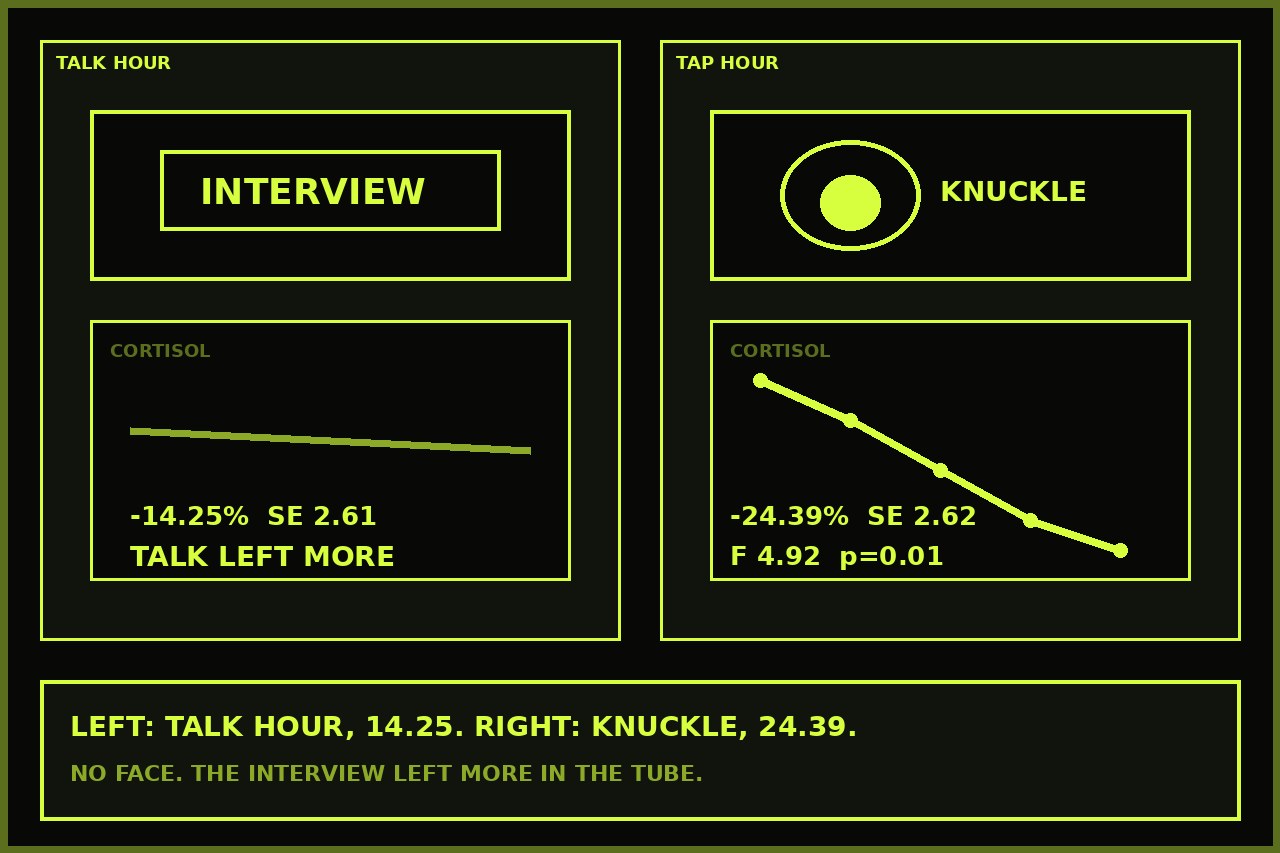
People who tapped dropped cortisol 24.39 percent, with an SE of 2.62. SE is how spread the percent change was. People who talked dropped cortisol 14.25 percent, with an SE of 2.61. When the team compared tapping with the talk hour, they printed p=0.022.
The team found the three groups split. They printed F(2,79)=4.92 and p=0.01. People who waited dropped cortisol 14.44 percent, with an SE of 2.67. When the team compared tapping with wait, they printed p=0.028. The team said people who talked and people who waited did not split.
You can still want the tapping to drop the stress hormone. People who talked also dropped cortisol 14.25 percent, so keep the talk hour too.
What is an 11-point heat line?
An 11-point heat line is how bad the thought feels from 0 to 10. People mark that line themselves during the tapping hour.
What is the SA-45 sheet?
SA-45 is a symptom sheet. GSI and PST are two totals on that sheet. People who tapped dropped anxiety 58.34, depression 49.33, GSI 50.50, and PST 41.93. The team printed a link between the PST total and the cortisol change, r=0.274, p=0.012. They printed a link between the GSI total and the cortisol change, r=0.304, p=0.005. r tells you how the two numbers moved together.
Did a later group also test EFT?
Stapleton and a later different group published in 2020. The journal is Psychological Trauma, volume 12, issue 8, pages 869 to 877. Fifty-three people joined a 60-minute group. People who used EFT in that later group dropped cortisol 43.24 percent. That was a different group in a later year. The numbers on this page come from Church 2012.
If you feel unusual distress or you need care, talk to a clinician, because this page is educational and not a diagnosis.
If you want a page about a moving circle that cooled the heat of a future crash picture, open the EMDR page.
Can you still want tapping to drop the stress hormone?
You wanted the tapping to drop the stress hormone after a talk already had a chair. Keep the EFT name.
People who tapped dropped cortisol 24.39 percent and people who talked dropped 14.25. You can still want the tapping to drop the stress hormone.
Sources
Church D., Yount G., Brooks A.J. “The Effect of Emotional Freedom Techniques on Stress Biochemistry: A Randomized Controlled Trial.” The Journal of Nervous and Mental Disease 2012, 200(10):891-896. DOI 10.1097/NMD.0b013e31826b9fc1. PMID 22986277. NCT00641394. Foundation for Epigenetic Medicine, Fulton CA, California Pacific Medical Center Research Institute, University of Arizona, five integrative clinics in California. n=83 nonclinical. 103 applied, 15 no-shows, 4 excluded for new trauma in last 20 minutes, 1 excluded for cortisol under 0.5 or over 6 ng/ml. Age 18 to 80, mean 51.30 SD 12.02, female 66 of 83 (79.5 percent). EFT cortisol percent change -24.39 SE 2.62 vs supportive interview -14.25 SE 2.61, pairwise EFT vs SI p=0.022. Rooms split F(2,79)=4.92, p=0.01. Wait room -14.44 SE 2.67, pairwise EFT vs wait p=0.028. Interview and wait did not split. EFT 50-minute session, certified life coach, Craig 2008/2011 manual, 12 points any order, 11-point heat line. SI 50-minute session, licensed psychologist or marriage and family therapist, CBT supportive interview. Second swab 30 minutes after the hour. Sabre Sciences, Carlsbad, CA, salivary cortisol. Baseline even F=0.62, p=0.541. SA-45 EFT anxiety -58.34, depression -49.33, GSI -50.50, PST -41.93. PST r=0.274, p=0.012. GSI r=0.304, p=0.005. doi.org/10.1097/NMD.0b013e31826b9fc1 · pubmed.ncbi.nlm.nih.gov/22986277 · ClinicalTrials.gov NCT00641394
Stapleton 2020 neighbor only. Psychological Trauma 12(8):869-877, n=53, 60-minute group, EFT -43.24 percent. Different group, later year. doi.org/10.1037/tra0000563 · pubmed.ncbi.nlm.nih.gov/32162958