Interoception · gut feeling · heartbeat counting
Heartbeat counting predicted who stayed on the trading desk.
You wanted the silent count to show who could stay after a sure feeling already sat in the chest.
Interoception is sensing what is going on inside the body. Heartbeat counting, also called the Schandry count, is when you count beats without touching a pulse. A pulse oximeter is a clip that reads the real pulse. Confidence, or the sure feeling, is how sure they felt they nailed the count. P&L is profit and loss, the money they made or lost. A high-frequency trader is a trader who makes many fast trades. A hedge fund is a money shop that trades for clients. Coeff and R2 tell you how the years and the score moved together. A field study means they tested people at work, not in a fake lab desk. Causation open means this does not prove the count made them stay. Keep the heartbeat-count name.
What is interoception?
Interoception is sensing what is going on inside the body, so you can feel hunger, pain, or a beat in the chest. People also call that a gut feeling. Keep the interoception name, because you wanted that silent count to show who stays.
What is heartbeat counting?
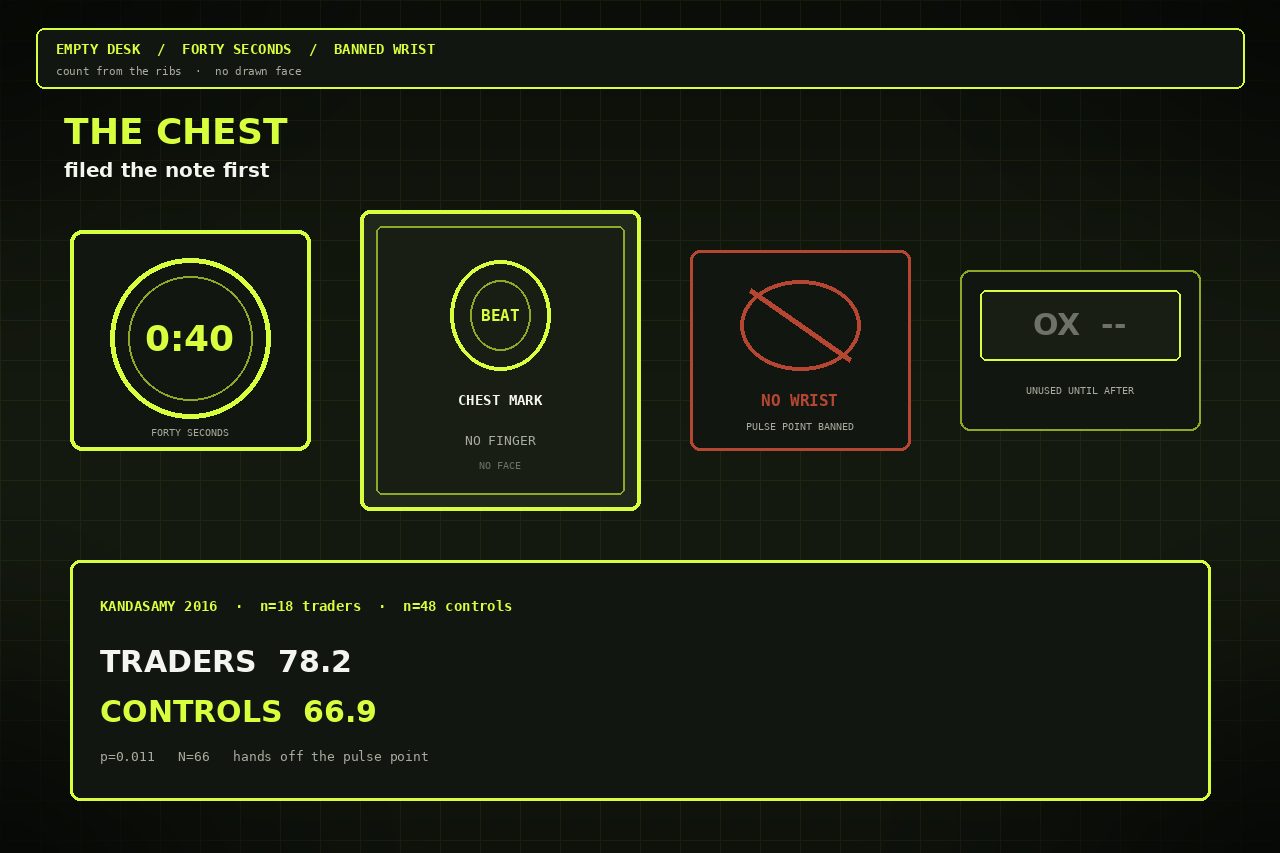
Heartbeat counting is when you count beats without touching a pulse, and people also call that the Schandry count. Schandry is just the name of that silent count. In this study, people counted through six clocks from 25 to 50 seconds, and they did not touch a chest or a pulse point. Then they wrote the number they felt. Keep the heartbeat-count name.
How does a pulse oximeter check the silent count?
A pulse oximeter is a clip that reads the real pulse. The team used that clip so they could see the real beat count while people wrote their number first. The team scored the count by comparing the written number with the real pulse, using this formula: (1 minus the gap between the real pulse and the written number, divided by the mean of those two numbers) times 100. A higher score means the written number was closer to the real pulse.
How sure did they feel they nailed the count?
The sure feeling is confidence, which is how sure they felt they nailed the count. After each clock, people marked how sure they felt. People who trust a gut can keep that trust. On this desk, the team still printed that the sure feeling missed the years, with p=0.54.
Did heartbeat counting predict who stayed on the trading desk?
Kandasamy, Garfinkel, Page, Hardy, Critchley, Gurnell, and Coates published this paper in 2016 in Scientific Reports after they tested 18 male high-frequency traders at a mid-sized London hedge fund. A high-frequency trader is a trader who makes many fast trades, and a hedge fund is a money shop that trades for clients. You can read the paper at doi.org/10.1038/srep32986.
The title of the paper is “Interoceptive Ability Predicts Survival on a London Trading Floor.” It also carries DOI 10.1038/srep32986, PMID 27641692, and PMC 5027524.
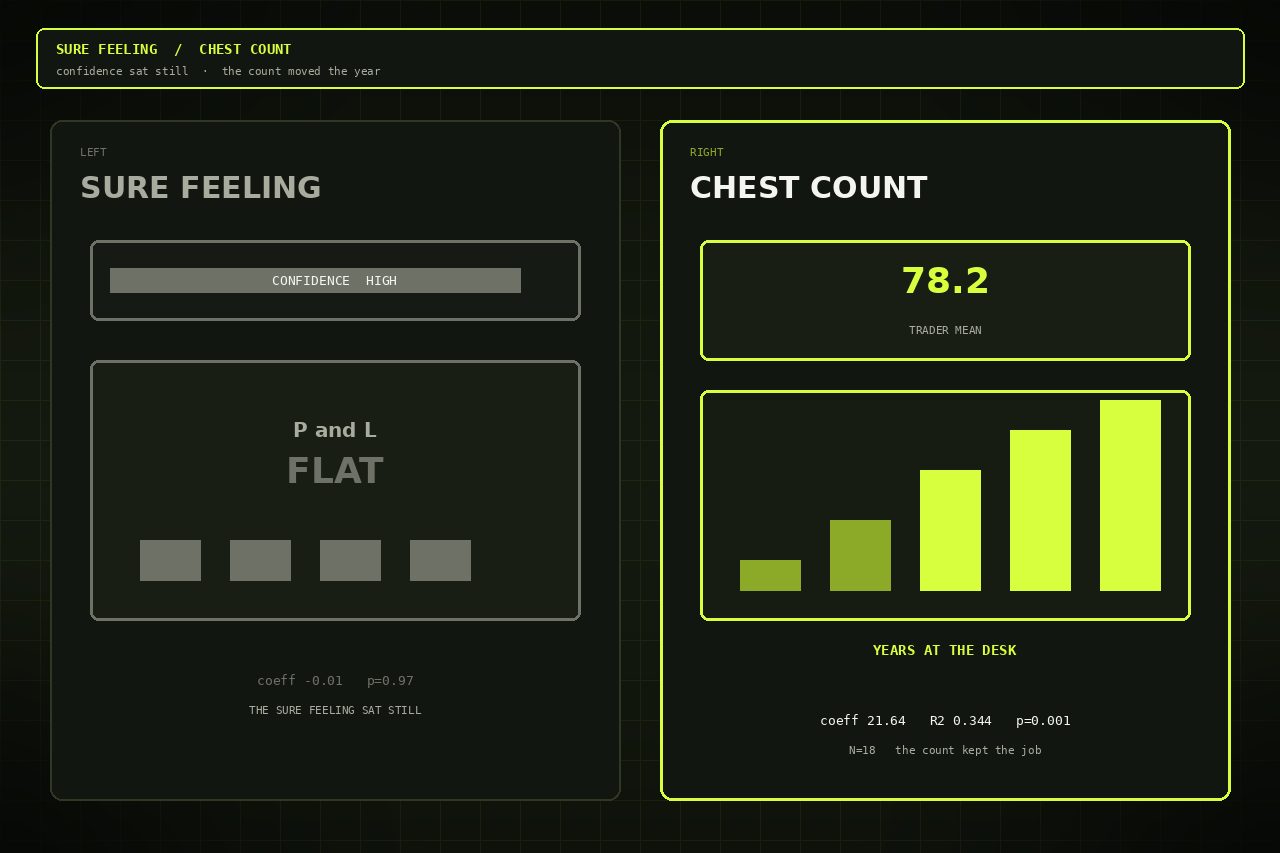
The team printed that the count predicted years on the desk, with years coeff=21.64, R2=0.344, p=0.001, and N=18. Coeff and R2 tell you how the years and the score moved together. A p value tells you how often a gap this big would show up if nothing had changed. N=18 means 18 traders sat down for that count. Keep wanting the silent count to show who stays.
Did traders count better than people who did not trade?
The team also tested 48 age-matched men who did not trade, in Sussex. Traders scored 78.2. The men who did not trade scored 66.9, and that gap was p=0.011 with N=66. N=66 means all 18 traders plus all 48 men in the other group.
Senior traders, the ones with more than 8 years on the desk, were 8 people with a mean score of 85.3, and that gap versus the other men was p=0.02. Junior traders, the ones with 1 to 4 years, were 5 people with a mean score of 68.7, and that gap versus the other men was p=0.852. The people who had already stayed longer also counted closer to the clip.
Did the sure feeling miss the years?
Yes. The sure feeling versus the years was coeff=-0.16, p=0.54, and the sure feeling versus how close the count was came out coeff=0.17, p=0.51. The sure feeling versus P&L, the money they made or lost, came out coeff=-0.01, p=0.97. The silent count still predicted the years. People who trust a gut can keep that trust in the rest of life. On this desk the sure feeling missed the years, and the silent count did not.
What does field study mean?
A field study means they tested people at work, not in a fake lab desk, so the team ran the count with traders on a London trading floor. Keep the field study in mind when you want the silent count to show who stays.
What does causation open mean?
Causation open means this does not prove the count made them stay. The team printed a field study, and the years and the score still moved together. You can still want the silent count to show who stays.
If you feel unusual distress or you need care, talk to a clinician, because this page is educational and not a diagnosis.
If you want a page about ten minutes of dim glass that changed the face, open the mirror gazing page.
Can you still want the silent count to show who stays?
You wanted the silent count to show who could stay after a sure feeling already sat in the chest. Keep the heartbeat-count name.
The silent count predicted years on the desk and the sure feeling missed those years. This was a field study, and causation is still open. You can still want the silent count to show who stays.
Sources
Kandasamy N., Garfinkel S.N., Page L., Hardy B., Critchley H.D., Gurnell M., Coates J.M. “Interoceptive Ability Predicts Survival on a London Trading Floor.” Scientific Reports 2016;6:32986. DOI 10.1038/srep32986. PMID 27641692. PMC 5027524. n=18 male high-frequency traders, mid-sized London hedge fund. Controls n=48 age-matched non-trader males, Sussex. Heartbeat counting, Schandry, six clocks 25-50 s, no chest or pulse point, pulse oximetry. Score = (1 - |actual-estimated| / mean(actual, estimated)) x 100. Traders 78.2 vs controls 66.9, p=0.011, N=66. Years coeff=21.64, R2=0.344, p=0.001, N=18. Confidence vs accuracy coeff=0.17 p=0.51. Vs P&L coeff=-0.01 p=0.97. Vs years coeff=-0.16 p=0.54. Senior >8 yrs n=8 mean 85.3 vs controls p=0.02. Junior 1-4 yrs n=5 mean 68.7 vs controls p=0.852. Field study. Causation open. doi.org/10.1038/srep32986 · pubmed.ncbi.nlm.nih.gov/27641692 · pmc.ncbi.nlm.nih.gov/articles/PMC5027524