Strange-face illusion · mirror gazing · dim glass
Ten minutes of mirror gazing changed the face for 66 percent.
You wanted the dim glass to change the face after ten minutes of looking.
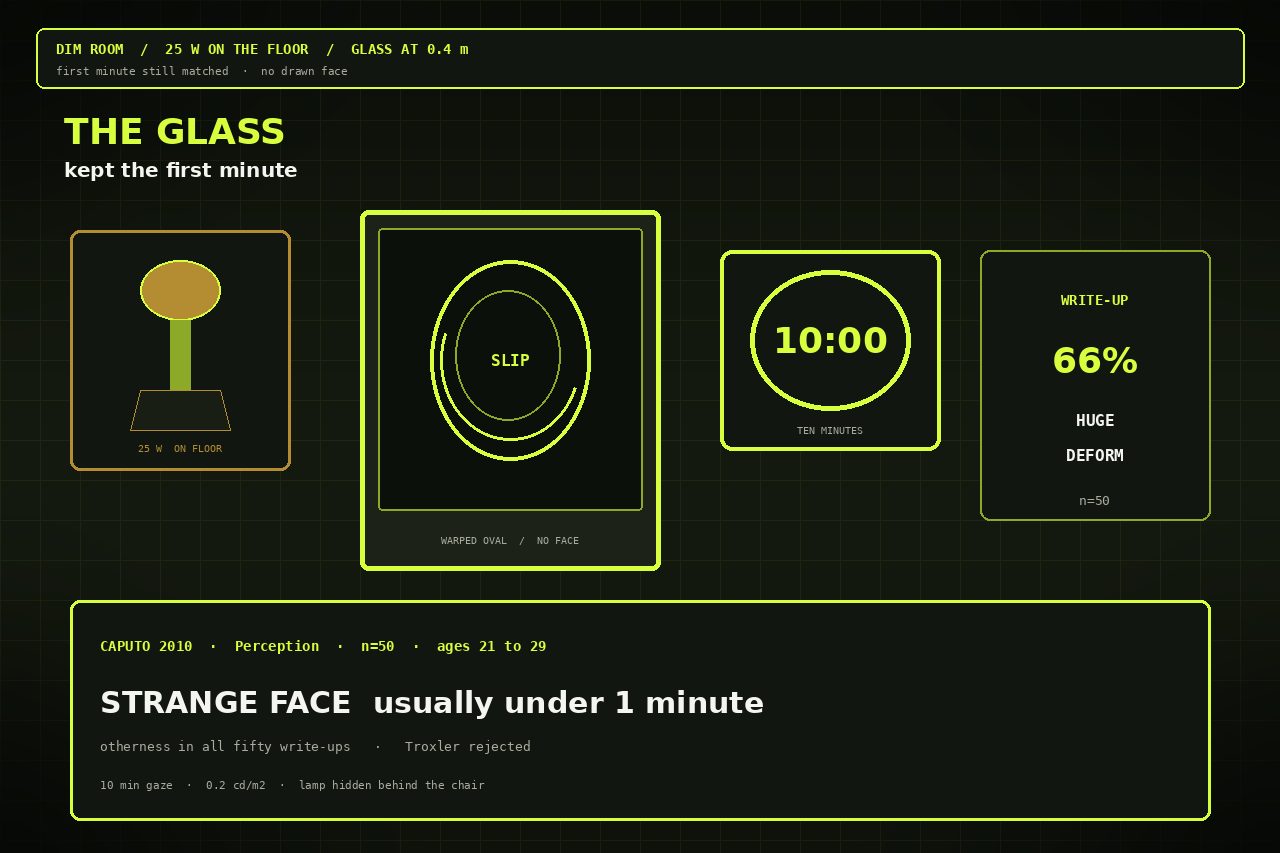
The strange-face illusion, also called mirror gazing, is when you look at your face in a dim mirror for ten minutes. Dim glass is that same dim mirror, and a 25-watt lamp is a dim lamp. Luminance is how bright the face was. Naive means the people had not heard the trick. Otherness means the face looked like someone else. Caputo ran this work at the University of Urbino, a university in Italy. Keep the strange-face name.
What is the strange-face illusion?
The strange-face illusion is when you look at your face in a dim mirror for ten minutes and you start to see someone else. People also call that mirror gazing. You wanted the dim glass to change the face after ten minutes of looking, so keep the strange-face name.
What is mirror gazing?
Mirror gazing is the same ten minutes of looking. You look at the face in the glass and you keep looking. People in this room usually saw a strange face after less than one minute, then they stayed with the glass for the full ten minutes. Then they wrote what they saw. Phenomenological means people wrote what they saw, so keep that writing.
What is dim glass?
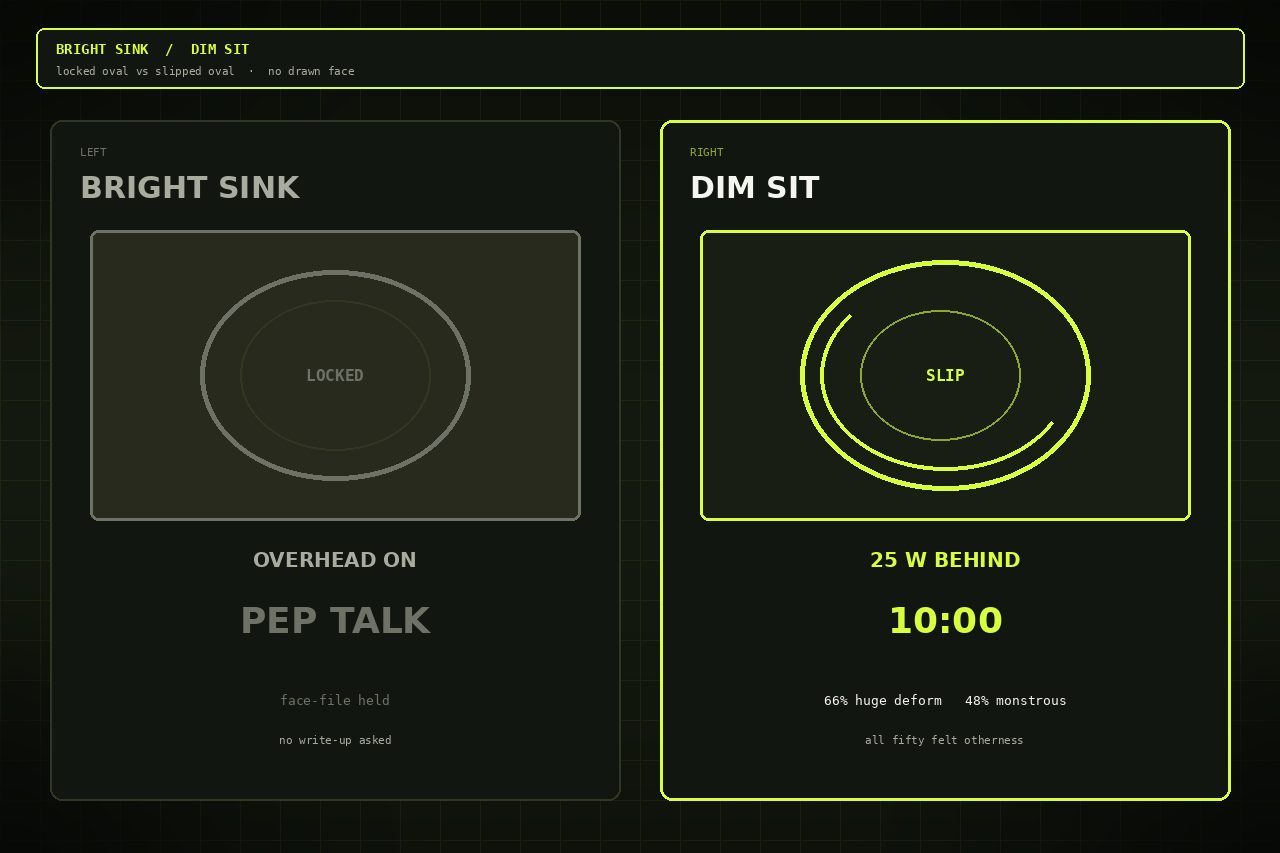
Dim glass is a mirror in a quiet room with a dim lamp. The team put a 25-watt lamp on the floor behind the person and hid that lamp from the eyes and from the glass. The mirror was 0.5 meters by 0.5 meters and about 0.4 meters in front, which is about an arm's length. Face luminance was about 0.2 candelas per square meter, which is a brightness number for how bright the face was. People could still see the face from 0.2 to 1.6. You wanted that dim glass to change the face, so keep the dim glass.
What is Troxler fading?
Troxler fading is a fade that happens when you stare. Some people use that name when a still picture starts to wash out. Caputo said new traits arrived, so he set Troxler aside. Keep that note.
What does no control arm mean?
A control arm is a comparison group. No control arm here means the team did not run a group of people who skipped the dim glass, or who looked in a bright room. The team still printed that sixty-six percent wrote huge deformations of their own face, and that all fifty wrote some form of otherness, so keep that fact. You can still want the ten minutes in dim glass.
What does no inferential p mean?
A p value is a stats test. No inferential p means the team did not run a stats test. People wrote what they saw, and the team counted those writings, so keep that count.
Did ten minutes of mirror gazing change the face?
Caputo published this paper in 2010 in Perception. He ran the work at the University of Urbino, a university in Italy. You can read the paper at doi.org/10.1068/p6466.
The title of the paper is “Strange-face-in-the-mirror illusion.” It also carries DOI 10.1068/p6466 and PMID 20842976.
Fifty naive people joined. Naive means they had not heard the trick. People were 21 to 29 years old, and the mean age was 23, with a spread of 2.1.
The room was quiet. People looked at the reflected face for ten minutes. People usually saw the strange-face after less than one minute, then each person wrote a description.
What kinds of faces did people write?
Sixty-six percent wrote huge deformations of their own face. Eighteen percent wrote a parent, with 8 percent still alive and 10 percent deceased. Twenty-eight percent wrote an unknown person, and twenty-eight percent wrote an archetypal face. Archetypal means a type of face people already know, like an old man or a child. Eighteen percent wrote an animal. Forty-eight percent wrote a fantastical or monstrous face. All fifty wrote some form of otherness, and otherness means the face looked like someone else. Keep wanting the dim glass to change the face.
If you feel unusual distress or you need care, talk to a clinician, because this page is educational and not a diagnosis.
If you want a page about an hour in a salt pool that dropped the anxiety sheet, open the float tank page.
Can you still want the dim glass to change the face?
You wanted the dim glass to change the face after ten minutes of looking. Keep the strange-face name.
Sixty-six percent wrote huge deformations of their own face and all fifty wrote some form of otherness. The team did not run a comparison group and the team did not run a stats test. You can still want the dim glass to change the face.
Sources
Caputo G.B. “Strange-face-in-the-mirror illusion.” Perception 2010;39(7):1007-1008. DOI 10.1068/p6466. PMID 20842976. University of Urbino. n=50 naive, ages 21 to 29, mean 23 SD 2.1. Quiet room, 25 W incandescent on the floor behind the observer, hidden from eyes and glass. Mirror 0.5 m by 0.5 m, about 0.4 m in front. Face luminance about 0.2 cd m-2, still present from 0.2 to 1.6. Gaze at reflected face. Strange-face usually after less than one minute. 10 min session, then a written description. Huge deformations 66 percent. Parent 18 percent (8 percent alive, 10 percent deceased). Unknown 28 percent. Archetypal 28 percent. Animal 18 percent. Fantastical or monstrous 48 percent. All fifty reported some form of otherness. Troxler rejected because new traits arrived. Phenomenological note. No control arm. No inferential p. doi.org/10.1068/p6466 · pubmed.ncbi.nlm.nih.gov/20842976 · journals.sagepub.com/doi/10.1068/p6466