Float tank · isolation tank · flotation REST
One hour in a float tank dropped anxiety in every person.
You wanted the hour in the salt pool to drop the anxiety sheet after the chest already felt tight.
Float tank, flotation REST, and isolation tank all mean you lie still in warm salt water in a quiet pool. REST here means Restricted Environmental Stimulation Therapy. STAI is an anxiety sheet people mark before they get in and after they get out. Open-label means people knew they were floating. No control arm means the team did not run a comparison group of anxious people who stayed out of the pool. Epsom is magnesium sulfate salt that makes the water dense. Feinstein and the team at the Laureate Institute for Brain Research in Tulsa ran this work. Keep the float name.
What is a float tank?
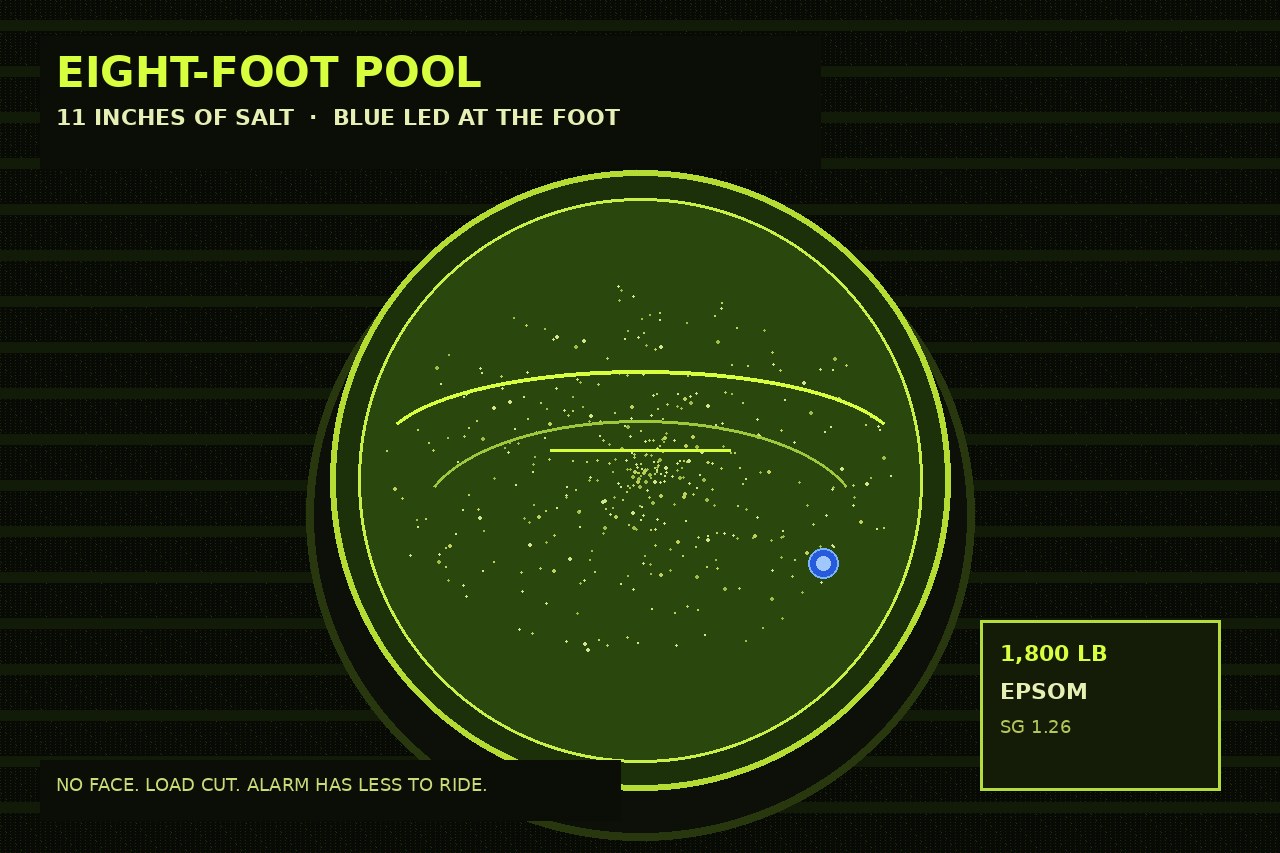
A float tank is a quiet pool where you lie still in warm salt water. People also call that a flotation tank, an isolation tank, or flotation REST. In this first hour, people lay in an open circular pool that was 8 feet across, with water 11 inches deep. The team put about 1,800 pounds of Epsom salt in that pool, and Epsom is magnesium sulfate salt that makes the water dense. Specific gravity is how dense the water is so you float. The team printed a specific gravity of 1.25 to 1.26. The team kept the water at 95.0 F and the air at 93.5 F. People could stay up to 60 minutes, and 48 of the 50 people stayed the full hour. You wanted that hour in the salt pool to drop the anxiety sheet after the chest already felt tight. Keep the float.
What is flotation REST?
Flotation REST is the same hour in that quiet pool. REST means Restricted Environmental Stimulation Therapy. People also say isolation tank. You lie still in warm salt water. Keep the REST name.
What is the STAI anxiety sheet?
STAI is an anxiety sheet people mark before and after. People in this first hour marked that sheet, then they floated, then they marked the same sheet again. Every person dropped the score on that sheet.
What is open-label?
Open-label means people knew they were floating. People could see the pool. The team still saw every person drop the anxiety sheet. Keep that fact.
What does no control arm mean?
A control arm is a comparison group. No control arm here means the team did not run a group of anxious people who stayed out of the pool. The team still printed that every person who floated dropped the anxiety sheet. Keep that fact too. You can still want that hour in the salt pool.
Did one hour in a float tank drop anxiety?
Feinstein, Khalsa, Yeh, Wohlrab, Simmons, Stein, and Paulus published this paper in 2018 in PLoS ONE. They ran the work at the Laureate Institute for Brain Research, a lab in Tulsa, Oklahoma. This was the open-label first session of NCT03051074. NCT03051074 is the trial number on ClinicalTrials.gov. You can read the paper at doi.org/10.1371/journal.pone.0190292.
The title of the paper is “Examining the short-term anxiolytic and antidepressant effect of Floatation-REST.” Anxiolytic means it drops anxiety. Antidepressant means it lifts a low mood. It also carries DOI 10.1371/journal.pone.0190292, PMID 29394251, and PMC 5796691.
Fifty anxious people joined, 16 male and 34 female. Mean age was 36.8, with a spread of 10.9, and people were 18 to 55 years old. None of them had floated before. Twenty-six people had GAD, which is generalized anxiety, and 46 people had depression. Twenty people were already taking an SSRI or an SNRI, which are common anxiety or depression pills. Fifteen people did not show.
How much did the anxiety sheet drop?
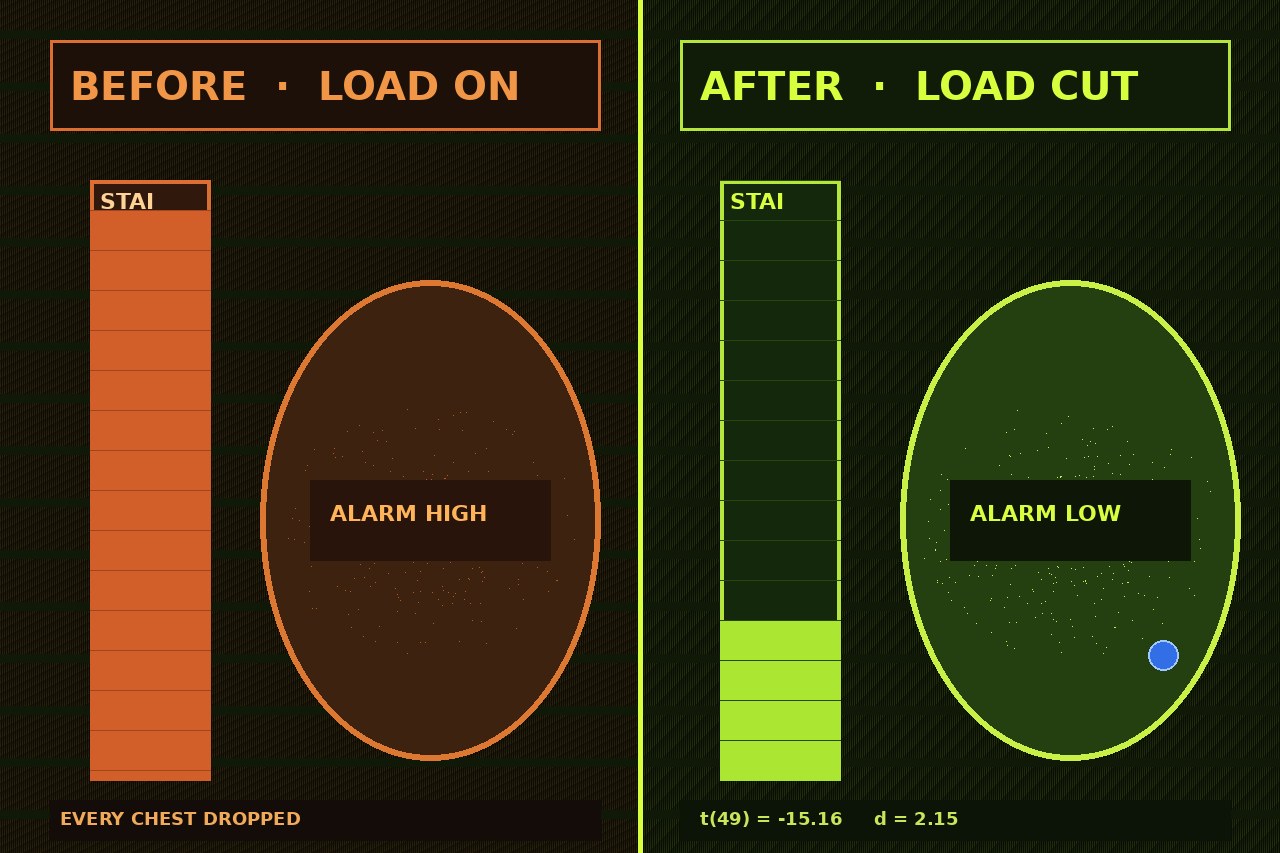
Every person in this first hour dropped the anxiety sheet. The team printed t(49)=-15.16, p under 0.0001, and d=2.15. t is the number the team printed for that drop. A p value tells you how often a gap this big would show up if nothing had changed, and d tells you how big the change was.
People also marked more serenity, with d=2.11, and they marked more refreshed, with d=2.39.
You can still want the salt-pool hour to drop the anxiety sheet.
Did lights-on still drop the anxiety sheet?
People who kept the lights on still dropped the anxiety sheet. The team printed lights-on STAI d=2.19. People who floated with the lights off dropped the sheet at d=2.15. Lights-on still dropped. Keep the lights-on hour too.
If you feel unusual distress or you need care, talk to a clinician, because this page is educational and not a diagnosis.
If you want a page about a squeeze-and-open tape that dropped the skin bar, open the PMR page.
Can you still want the hour in the salt pool to drop the sheet?
You wanted the hour in the salt pool to drop the anxiety sheet after the chest already felt tight. Keep the float name.
Every person in this first hour dropped the anxiety sheet. People knew they were floating, and the team did not run a comparison group of anxious people who stayed out of the pool. Lights-on still dropped. You can still want the hour in the salt pool to drop the sheet.
Sources
Feinstein J.S., Khalsa S.S., Yeh H-w., Wohlrab C., Simmons W.K., Stein M.B., Paulus M.P. “Examining the short-term anxiolytic and antidepressant effect of Floatation-REST.” PLoS ONE 2018;13(2):e0190292. DOI 10.1371/journal.pone.0190292. PMID 29394251. PMC 5796691. Laureate Institute for Brain Research, Tulsa. Open-label first session of NCT03051074. n=50 anxious, 16 male 34 female, mean age 36.8 SD 10.9, never floated, ages 18-55. Open circular pool 8 ft, 11 in water, about 1,800 lb Epsom, specific gravity 1.25-1.26. Water 95.0 F, air 93.5 F, up to 60 min, 48 of 50 full hour. Every STAI score fell, t(49)=-15.16, p under 0.0001, d=2.15. Lights-on STAI d=2.19 vs lights-off d=2.15. Serenity d=2.11, refreshed d=2.39. Open-label, no anxious control arm. GAD n=26, depression n=46, SSRI/SNRI n=20, 15 no-shows. doi.org/10.1371/journal.pone.0190292 · pubmed.ncbi.nlm.nih.gov/29394251 · pmc.ncbi.nlm.nih.gov/articles/PMC5796691 · ClinicalTrials.gov NCT03051074