Mechanism · Gateway Process · Hemi-Sync · Beat frequency
Gateway Process: Hemi-Sync in headphones
McDonnell, 9 June 1983, Army memo: the Gateway Experience is a Hemi-Sync training system, and the PDF lists no trial n. Dabu-Bondoc 2010 ran an RCT with Hemisync n=20 against music n=20 against a blank cassette n=20. Intraoperative fentanyl dropped, P<0.05. Pain VAS dropped at 1 hour (P=0.02) and at 24 hours (P=0.005), and discharge came earlier (P=0.048). Brief report. Analgesia on a table.
I opened the Black Vault PDF of CIA-RDP96-00788R001700210016-5. The date on the letterhead is 9 June 1983, and the author is LTC Wayne M. McDonnell, US Army Operational Group, Fort Meade. He called the Gateway Experience a Hemi-Sync training system. He put two audible carriers in the ears and named the gap a beat frequency. He then hung Frequency Following Response on the follow-on. The PDF is a memo, and no trial n sits in it.
A YouTube of that CIA release will tell you the tapes hop you through time. McDonnell named a training ladder Robert Monroe already sold. I stayed with the sentences the PDF locked. I left the cosmic-egg tour in the memo where I found it. Reality Engineering is the science of making reality respond to intent. The hardware on this URL is a difference tone in headphones.
I wanted the file to be a methods table. It is an Army officer thinking on paper after he sat through the Monroe course, and then trying to hang physics language on a headphone trick the Institute already sold. That is still a mechanism you can name. It is still a memo. The later numbers live in anesthesia journals, and they measure fentanyl and propofol, which is a different job than Focus 21.
Two ears, one beat frequency
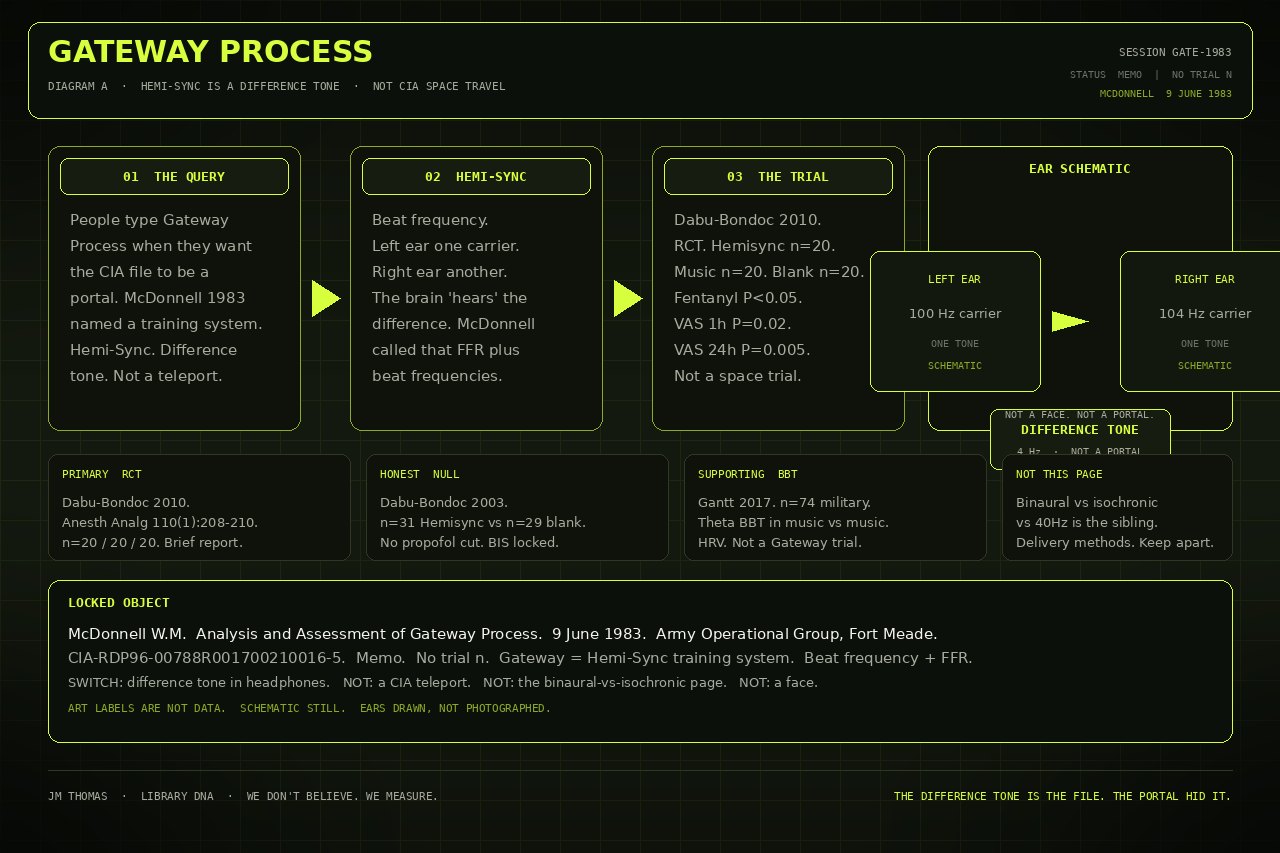
Hemi-Sync is hemispheric synchronization by a beat frequency. Left ear gets one audible tone, and the right ear gets a slightly different audible tone, so the brain reports the gap. McDonnell called that gap a beat frequency and then hung Frequency Following Response on it.
Hemi-Sync is a Monroe product name. McDonnell quotes Melissa Jager, a Monroe Institute trainer, for the state he wants: "EEG patterns of both hemispheres simultaneously equal in amplitude and frequency." That sentence lives in the memo. It is a definition inside an Army paper. The PDF did not attach a stadium EEG count.
The hardware move is simple enough to draw. Play one tone left. Play a neighbor tone right. Each ear hears its own carrier. The interesting object is the difference. If that difference sits near a brain-rhythm band, McDonnell says the brain tries to match. He named the match Frequency Following Response. Memo language on a Monroe product name: two carriers plus one gap.
You can run a difference tone without buying a Monroe tape. Stereo isolation still matters. A kitchen speaker collapses both carriers into one room. The beat the memo described needs a left channel and a right channel. Headphones do that job. I treated that as the mechanism, and I stopped before turning a Spotify playlist into the Gateway Experience.
The 100 Hz / 104 Hz pair on the hero still is drawn. I treated those labels as art. McDonnell memo did not lock that pair as a lab measurement. If you want Oster, the delivery-method table, and the kitchen-listen warning, that work lives on binaural vs isochronic vs 40Hz. This URL stays on the Gateway file.
McDonnell 9 June 1983 memo
McDonnell W.M. Analysis and Assessment of Gateway Process, 9 June 1983, US Army Operational Group, Fort Meade, CIA-RDP96-00788R001700210016-5. I read the Black Vault PDF. It is a memo with no trial n. He named Gateway as a training system that uses Hemi-Sync to bring left and right hemisphere brainwave output into coherent amplitude and frequency.
The letterhead is Department of the Army. US Army Operational Group. US Army Intelligence and Security Command. Fort George G. Meade, Maryland 20755. Date 9 June 1983. Subject: Analysis and Assessment of Gateway Process. To: Commander, US Army Operational Group. The signature block on the copy I had reads LTC, MI, Commander, Detachment. The later public file number is CIA-RDP96-00788R001700210016-5. I sat with that PDF. I did not sit in Fort Meade.
Paragraph 1 is the tasking. Provide an assessment of the Gateway Experience in terms of its mechanics and practicality. McDonnell says he took the Gateway training. He used Itzhak Bentov biomedical models for the physical side. He then reached for quantum mechanics and theoretical physics to talk about consciousness and time-space. An Army officer building a model. The PDF has no methods table and no enrolled n.
The locked claim sits in section 5. "Fundamentally, the Gateway Experience is a training system designed to bring enhanced strength, focus and coherence to the amplitude and frequency of brainwave output between the left and right hemispheres so as to alter consciousness, moving it outside the physical sphere so as to ultimately escape even the restrictions of time and space." That is his sentence. I copied it here. I am not running it as a Tuesday promise.
The differentiator, in the same section, is Hemi-Sync. Everything after that is a tour. He walks through hypnosis and TM and biofeedback, then a lamp-versus-laser picture of coherence. Beat frequencies and FFR sit next to Bentov resonance and a hologram story. Focus 10 / 12 / 15 / 21 show up as ladder names. Patterning. Remote viewing as a later tool. Out-of-body notes. The bibliography starts with Bentov and with Monroe Journeys Out of the Body.
Focus numbers are Monroe ladder names. Focus 10 is the body-asleep, mind-awake rung in that language. Focus 12 is expanded awareness. Focus 15 is a no-time label. Focus 21 is the bridge label. Those names live in the memo. They arrive with trainer talk, including a line that fewer than five percent reach Focus 15. Trainer talk. I left that line inside the memo. I did not promote it to a trial n.
Other numbers in the tour stayed citations. Monroe 2877.3 CPS is attributed to a magazine quote. I have not opened that magazine. Greene at Menninger and Twemlow watt metaphor are names inside the memo. I did not open those papers. Planck Distance stays a model line. The cosmic egg stays a model line. Bentov stays a citation McDonnell used. The memo is the file I can stand on. The trials come later, and they count analgesia.
9 June 1983 at Fort Meade is a memo with no trial n. Training system. Hemi-Sync. Beat frequency plus FFR. I left the physics tour as a tour.
Dabu-Bondoc 2010 on the table
Yale 2010 brief report in Anesth Analg 2010;110(1):208-210. DOI 10.1213/ANE.0b013e3181bea424. PMID 19861358. RCT with Hemisync n=20 against music n=20 against blank n=20. Intraoperative fentanyl lower P<0.05. VAS lower at 1 h P=0.02 and 24 h P=0.005. Discharged earlier P=0.048. Europe PMC abstract. Analgesia.
Susan Dabu-Bondoc and colleagues at Yale published this in Anesthesia and Analgesia, January 2010, 110(1):208-210. Published ahead of print 27 October 2009. DOI 10.1213/ANE.0b013e3181bea424. PMID 19861358. Randomized controlled trial and brief report on surgical outpatients in three arms. Hemisync sounds n=20 against music n=20 against a blank cassette n=20. Standardized propofol-nitrous-vecuronium and fentanyl general anesthesia. That is the n. The abstract printed no fourth arm. The abstract printed no microgram figure I can quote.
The LWW publisher page showed the same abstract and then a subscriber wall. I used the sentences the abstract locked. I did not sit inside the full PDF. A three-page brief report is still a brief report. I kept it in that size.
Intraoperative fentanyl consumption was lower in the treatment group, P<0.05. Postoperative pain VAS was lower in the Hemisync group at 1 hour, P=0.02, and at 24 hours, P=0.005. Discharge was earlier, P=0.048. The conclusion on the abstract is narrow. Hemisync sounds before and during general anesthesia reduce intraoperative analgesic requirements. Postoperative pain scores dropped. Discharge time dropped with them.
Why a music arm. Because a pretty sound can calm a room without a beat frequency. Why a blank cassette. Because headphones and a ritual already change a morning. The Hemisync arm had to beat both. On the abstract I used, it did, on fentanyl, on VAS, and on discharge clock. Analgesia on a surgery table. Headphones. A branded Hemisync recording counted against music and against silence.
This trial measured pain and opioid on outpatients. Consciousness hops, out-of-body claims, and remote viewing sit outside the abstract. Useful and supporting, and enough to stop calling Hemi-Sync a metaphor. Small brief report, tied to a product name and a surgery protocol.
The 2003 propofol null
Dabu-Bondoc 2003, Anesth Analg 97(3):772-775. PMID 12933400. RCT. Hemisync n=31 vs blank n=29. Propofol induction 2.49 +/- 0.59 vs 2.60 +/- 0.59 mg/kg, P=0.48. Maintenance 0.141 +/- 0.02 vs 0.146 +/- 0.04 mg per kg per min, P=0.62. BIS held the hypnotic component. Honest null. Europe PMC abstract.
The 2010 brief report is the analgesia file. The 2003 paper is the honest null. Same first author. Same journal family. Different question. Does Hemisync reduce the hypnotic component of anesthesia when a bispectral index monitor holds depth?
Full author line on the abstract: Dabu-Bondoc S., Drummond-Lewis J., Gaal D., McGinn M., Caldwell-Andrews A.A., Kain Z.N. Hemispheric synchronized sounds and intraoperative anesthetic requirements. Anesthesia and Analgesia 2003;97(3):772-775. DOI 10.1213/01.ANE.0000076145.83783.e7. PMID 12933400. RCT. Hemisync n=31. Blank cassette n=29. Propofol-based anesthetic. BIS used so the hypnotic component stayed the same. Induction propofol 2.49 +/- 0.59 mg/kg versus 2.60 +/- 0.59 mg/kg, P=0.48. Maintenance 0.141 +/- 0.02 versus 0.146 +/- 0.04 mg per kg per min, P=0.62. No difference for high state anxiety either. Conclusion on the abstract: Hemisync sounds do not reduce the hypnotic component of the anesthetic state.
Hold both papers. Analgesia moved in 2010, and hypnotic dose with BIS locked stayed put in 2003. Same product name, two questions. A portal story needs one paper. The stack gives you the pair.
Lewis 2004 and Gantt 2017
Lewis A.K., Osborn I.P., Roth R. The effect of hemispheric synchronization on intraoperative analgesia. Anesth Analg 2004;98(2):533-536. DOI 10.1213/01.ANE.0000096181.89116.d2. PMID 14742401. Double-blind RCT. Europe PMC abstract. Bariatric patients on Hemi-Sync used 0.015 versus 0.024 micrograms per kg per min of fentanyl, P=0.009. Lumbar patients were similar, 0.012 versus 0.015. Isoflurane was similar. The abstract I used did not lock a subject count. I left that cell empty. Supporting anesthesia file. Separate from the Gateway memo.
Gantt M.A. et al. The Effect of Binaural Beat Technology on the Cardiovascular Stress Response in Military Service Members With Postdeployment Stress. Journal of Nursing Scholarship 2017;49(4):411-420. DOI 10.1111/jnu.12304. PMID 28544507. Double-blind randomized trial. n=74 military service members. Music with embedded theta BBT versus music alone. Thirty minutes at bedtime, three nights a week, four weeks. LF HRV decreased 2.5 ms2/Hz in the BBT arm and increased 7.99 in music-only, P=.01. HF increased 2.5 versus decreased 7.64. Total power dropped 26.68 versus 1,113.64. Europe PMC abstract. Military BBT in music. Supporting binaural-in-music count. I kept it off the Gateway tape claim and off Focus 12.
Later files, separate jobs. 2010 counted fentanyl and VAS on Hemisync. 2003 left propofol alone with BIS locked. 2004 moved bariatric fentanyl and left the subject n off the abstract. 2017 ran theta beats inside music for military HRV. I used Gantt as a neighbor, and I kept it off the Monroe tape claim.
Drawn Hertz on the still
The hero still shows 100 Hz in one ear and 104 Hz in the other. Those numbers are drawn. McDonnell memo did not lock that pair as a lab measurement. I treated the labels as art. A 4 Hz gap is a common classroom sketch for a theta-ish difference. Classroom sketch. The PDF I opened did not print 100 and 104 as a measured trial pair.
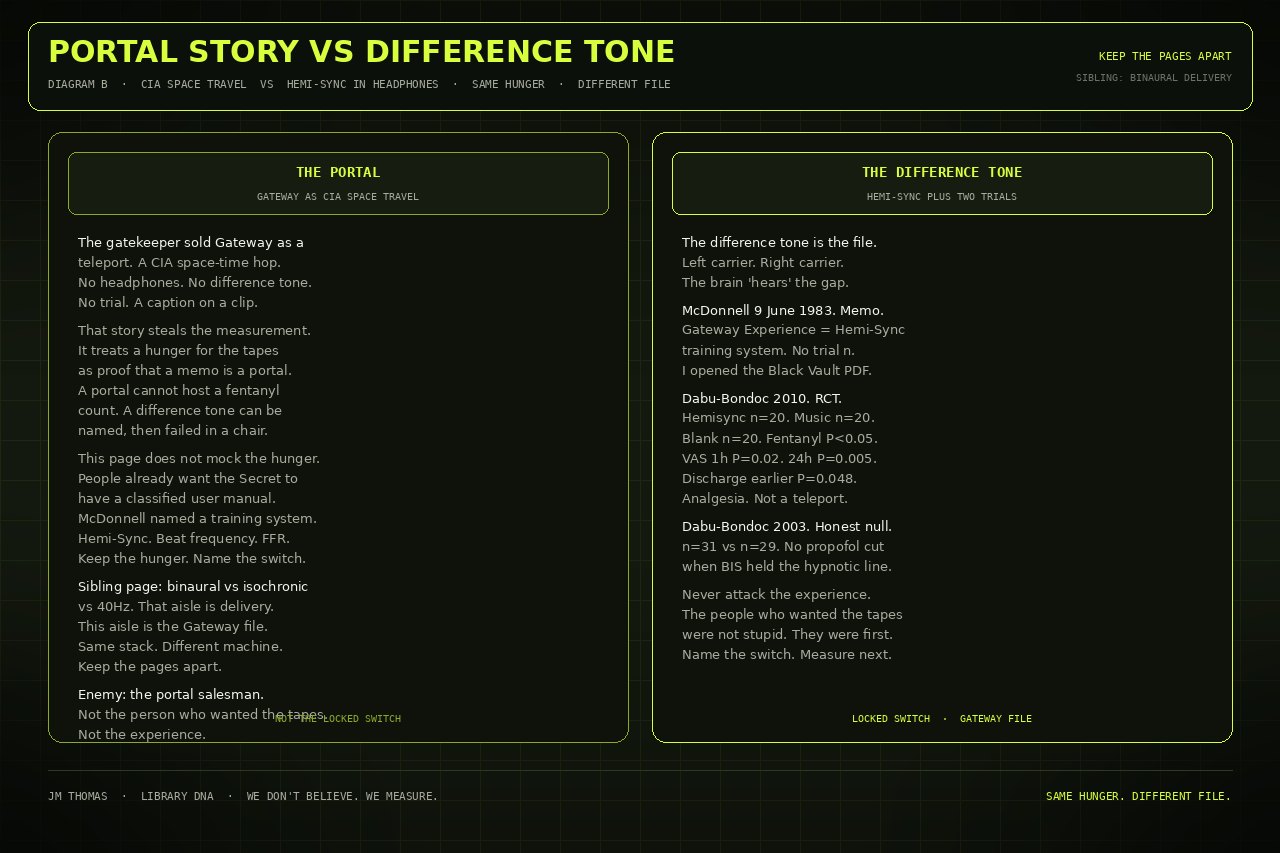
The compare still splits a portal cartoon from a headphone diagram. Same rule. Drawn. You can use the picture to remember two ears and a gap, and you cannot quote the footer Hertz as data. I drew the pair so a reader who came in from a CIA-PDF video could see the headphone move in one glance.
| File | Locked number |
|---|---|
| McDonnell 1983 | Memo. No trial n. Hemi-Sync training system. Beat frequency plus FFR |
| Dabu-Bondoc 2010 | RCT. Hemisync n=20, music n=20, blank n=20. Fentanyl P<0.05. VAS 1 h P=0.02, 24 h P=0.005. Discharge P=0.048 |
| Dabu-Bondoc 2003 | RCT. n=31 vs n=29. Propofol induction P=0.48. Maintenance P=0.62. Honest null |
| Lewis 2004 | Bariatric fentanyl 0.015 vs 0.024, P=0.009. Subject n blank on the abstract |
| Gantt 2017 | Military BBT n=74. Theta in music vs music. HRV |
| 100 / 104 Hz still | Drawn carriers on the hero |
Protocol 01 tonight
You will not get a Hemisync analgesia trial from a kitchen chair. You can get a 1 to 10 on whether the line is quieter, and a binary on whether you ran a sequence you can start and leave. Protocol 01 is free: four-count inhale, eight-count exhale, seven minutes, with the number written before and the number written after. This URL is the Gateway file. The Library of Biological Wizardry is the rest of the stack when you want the next hour. No initiate password. A sequence, then a measurement. We don't believe. We measure.
McDonnell named Hemi-Sync. Dabu-Bondoc counted fentanyl. The 2003 paper left propofol alone. The hunger that sent you to the CIA PDF can sit next to a seven-minute count. Measure the next hour.
FAQ
Short answers. Visible text matches the FAQ schema. Drawn stills. Educational page.
Did McDonnell enroll a Gateway trial in 1983?
No. Analysis and Assessment of Gateway Process, 9 June 1983, CIA-RDP96-00788R001700210016-5, is a memo. I read the Black Vault PDF. He named a Hemi-Sync training system. Beat frequency plus FFR. The PDF lists no trial n.
What n did Dabu-Bondoc 2010 lock?
Hemisync 20, music 20, blank 20. Fentanyl P<0.05. VAS 1 hour P=0.02. VAS 24 hours P=0.005. Discharge P=0.048. Brief report in Anesth Analg 2010;110(1):208-210. Analgesia.
Did Hemisync cut propofol in 2003?
No. n=31 versus n=29, with induction P=0.48 and maintenance P=0.62 while BIS held depth. Honest null. Anesth Analg 2003;97(3):772-775.
What subject n does Lewis 2004 print?
The Europe PMC abstract I used does not print one. Bariatric fentanyl 0.015 versus 0.024 micrograms per kg per min, P=0.009. I left the n cell empty.
What did Gantt 2017 actually run?
Music with embedded theta binaural beats in 74 military service members. HRV moved. I filed it as supporting binaural-in-music. I kept it off the Monroe tape claim.
Can I quote 100 Hz and 104 Hz as trial carriers?
No. Those Hertz labels live on the hero still, and they are drawn. McDonnell memo did not lock that pair.
What do I run tonight for a number?
Protocol 01. Four-count inhale, eight-count exhale, seven minutes, with a number written before and a number written after. This URL is the Gateway file.
Does this page treat anyone?
Educational explainer by JM Thomas, with no diagnosis, no treatment, no cure, and no prevention claim. McDonnell 1983 is a memo. Dabu-Bondoc 2010 and 2003 are anesthesia trials. Gantt 2017 is a military BBT trial. Talk to a clinician if unusual distress shows up.
Files I opened
Black Vault PDF I sat with. McDonnell, W.M. "Analysis and Assessment of Gateway Process." US Army Operational Group, Fort Meade. 9 June 1983. CIA-RDP96-00788R001700210016-5. Memo. No trial n. Gateway Experience named as a Hemi-Sync training system. Beat frequency plus Frequency Following Response. Bentov and Monroe sit in the bibliography. Jager is quoted in the body. I did not open those as separate papers. documents2.theblackvault.com/documents/cia/CIA-RDP96-00788R001700210016-5.pdf
Same memo via CIA Reading Room filename. Jina fetch returned title and page count, body empty on that pass. Full text used was the Black Vault PDF above. cia.gov/readingroom/docs/CIA-RDP96-00788R001700210016-5.pdf
2010 analgesia brief report I used at Europe PMC. Title: "Hemispheric synchronized sounds and perioperative analgesic requirements." Anesthesia and Analgesia 2010;110(1):208-210. DOI 10.1213/ANE.0b013e3181bea424. PMID 19861358. RCT. Brief report. I used the Europe PMC abstract. LWW full text was behind a subscriber wall. Hemisync n=20, music n=20, blank n=20. Intraoperative fentanyl P<0.05. VAS 1 h P=0.02, 24 h P=0.005. Discharge P=0.048. europepmc.org/article/MED/19861358
2003 hypnotic-dose paper I used at Europe PMC. Title: "Hemispheric synchronized sounds and intraoperative anesthetic requirements." Anesthesia and Analgesia 2003;97(3):772-775. DOI 10.1213/01.ANE.0000076145.83783.e7. PMID 12933400. RCT. I used the Europe PMC abstract. Hemisync n=31 vs blank n=29. Propofol induction 2.49 +/- 0.59 vs 2.60 +/- 0.59 mg/kg, P=0.48. Maintenance 0.141 +/- 0.02 vs 0.146 +/- 0.04 mg per kg per min, P=0.62. Honest null on the hypnotic line with BIS locked. europepmc.org/article/MED/12933400
2004 bariatric analgesia paper I used at Europe PMC. Lewis A.K. et al. "The effect of hemispheric synchronization on intraoperative analgesia." Anesthesia and Analgesia 2004;98(2):533-536. DOI 10.1213/01.ANE.0000096181.89116.d2. PMID 14742401. Double-blind RCT. I used the Europe PMC abstract. Bariatric fentanyl 0.015 vs 0.024 micrograms per kg per min, P=0.009. Lumbar 0.012 vs 0.015. Subject n not locked on the abstract. I left that cell empty. europepmc.org/article/MED/14742401
2017 military BBT paper I used at Europe PMC. Gantt M.A. et al. "The Effect of Binaural Beat Technology on the Cardiovascular Stress Response in Military Service Members With Postdeployment Stress." Journal of Nursing Scholarship 2017;49(4):411-420. DOI 10.1111/jnu.12304. PMID 28544507. Double-blind RCT. n=74. I used the Europe PMC abstract. Music plus theta BBT versus music. Supporting BBT file. I kept it off the Gateway tape claim. europepmc.org/article/MED/28544507