Intermittent fasting · 8-hour window · calorie counting
An 8-hour eating window did not beat calorie counting.
You wanted the clock to do extra work after the calories were the same.
An 8-hour eating window is time-restricted eating. Time-restricted eating means you eat only from 8am to 4pm. Calorie counting means you eat the same calories with no clock. A calorie, also written kcal, is the energy in food. Intermittent fasting is the family name for eating on a clock. Liu and the team at Nanfang Hospital in Guangzhou ran this work. Nanfang is the hospital in Guangzhou. Keep the 8-hour window name.
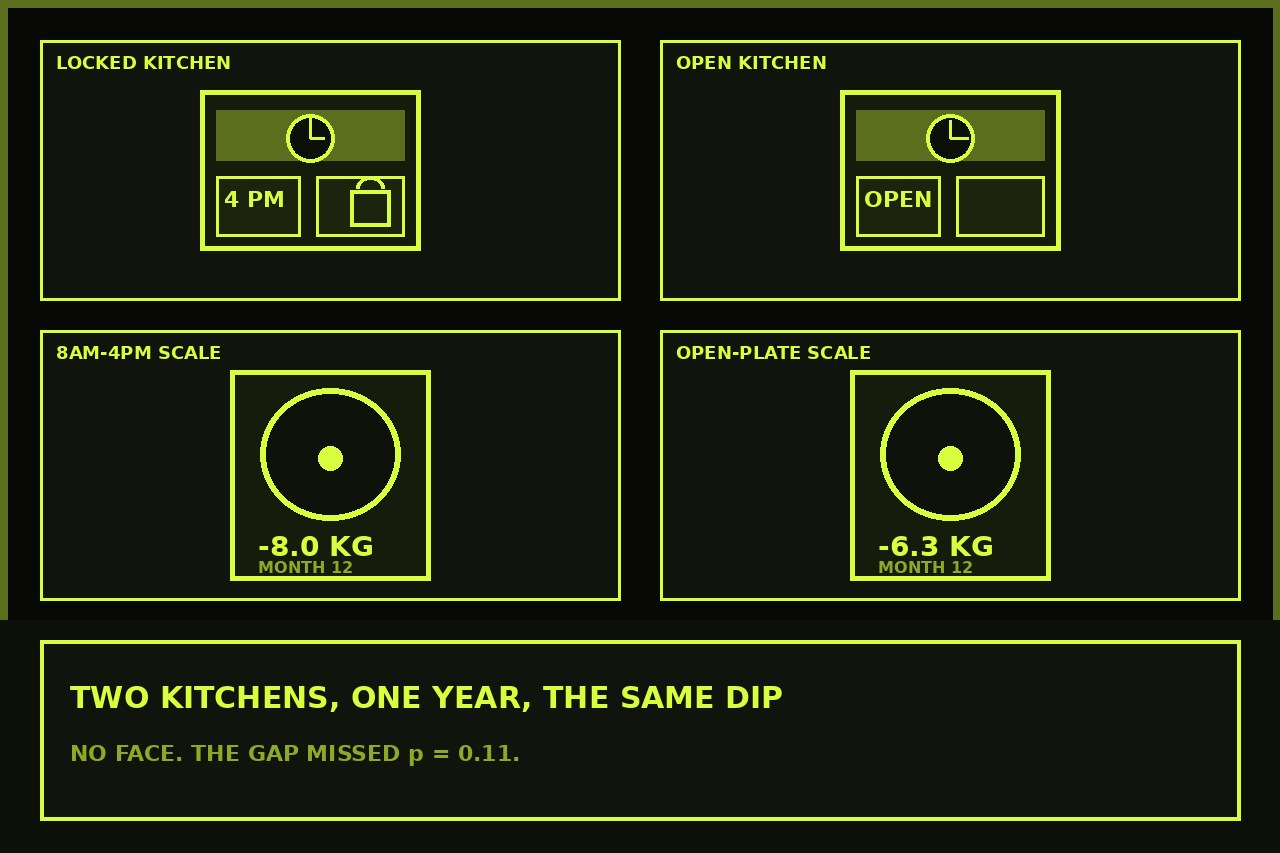
What is an 8-hour eating window?
An 8-hour eating window is time-restricted eating. You eat only from 8am to 4pm. After 4pm you can still drink calorie-free liquids. A calorie-free liquid has no energy in it, so it does not add to the count. People use that clock when they want a clear stop time, and when they want help with hunger at night.
You wanted the clock to do extra work after the calories were the same. Keep the 8-hour window.
What is calorie counting?
Calorie counting means you eat the same calories with no clock. You still cut how much you eat. You just do not stop at 4pm. In this study both groups used the same calorie target.
What is intermittent fasting?
Intermittent fasting is the family name for eating on a clock. An 8-hour eating window is one way people do that. This page is about that 8am to 4pm window next to calorie counting.
Did an 8-hour eating window beat calorie counting?
Liu, Huang, and the team published this paper in 2022. The journal is the New England Journal of Medicine. They ran the work at Nanfang Hospital in Guangzhou. Nanfang is the hospital in Guangzhou. You can read the paper at doi.org/10.1056/NEJMoa2114833.
The title of the paper is “Calorie Restriction with or without Time-Restricted Eating in Weight Loss.” It also carries DOI 10.1056/NEJMoa2114833, PMID 35443107, and NCT03745612.
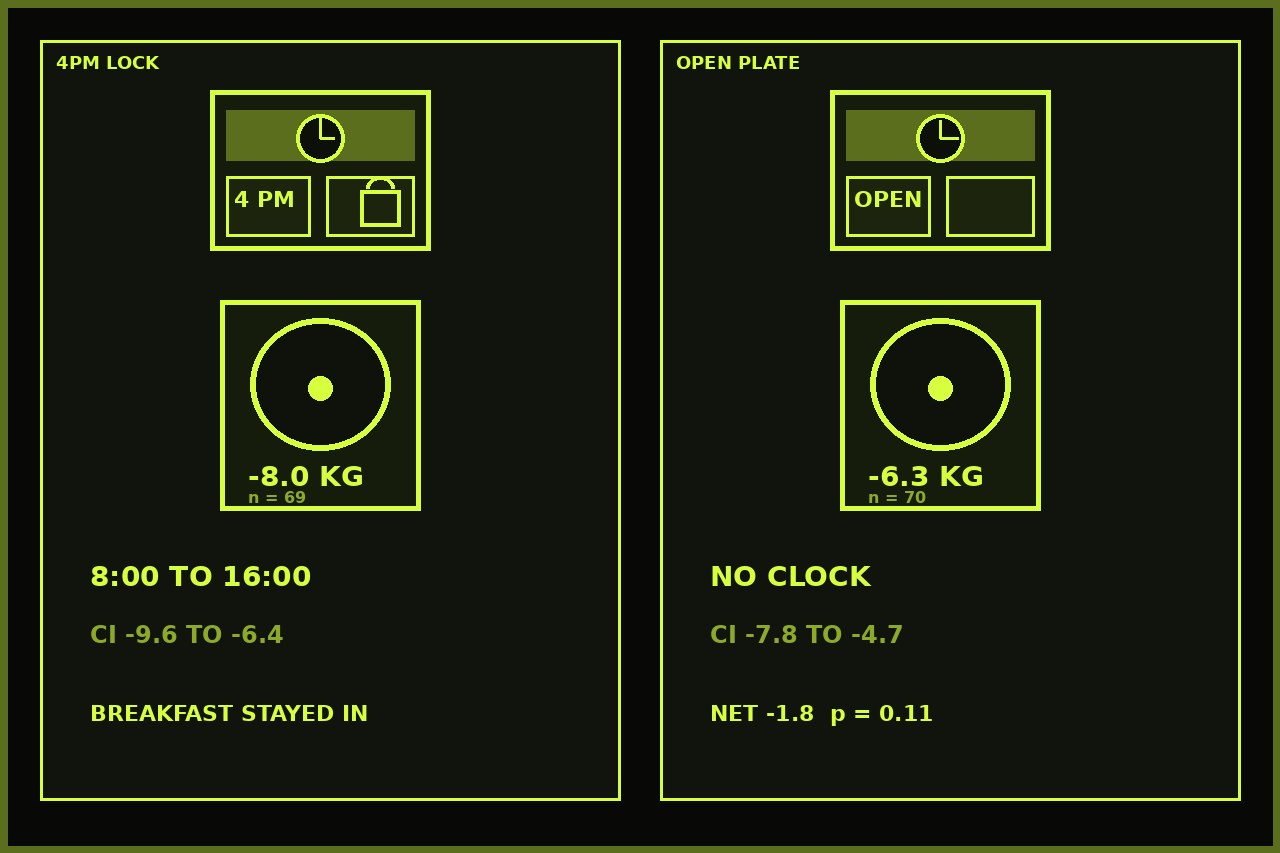
The team put 139 people into two rooms, meaning two groups. 69 people ate in the 8-hour window. 70 people counted the same calories with no clock. They stayed with the plan for 12 months. 118 people finished, which is 84.9 percent. Mean age was 31.9, and mean weight was 88.2 kilograms.
Men ate 1500 to 1800 calories a day. Women ate 1200 to 1500. That was about 75 percent of what they ate before they started. People in the 8-hour room ate from 8am to 4pm. People in the calorie-counting room ate those same calories with no clock. After 4pm, people in the 8-hour room could drink calorie-free liquids.
How much weight did people lose?
At month 12, people who ate 8am to 4pm lost 8.0 kilograms. The range they printed ran from 9.6 down to 6.4. People who counted the same calories with no clock lost 6.3 kilograms. That range ran from 7.8 down to 4.7. The gap between the rooms was 1.8 kilograms, from a 4.0 drop to a 0.4 gain. The p value was 0.11. A p value tells you how often a gap this big would show up if the groups were the same. The team sized the study to catch a 2.5 kilogram gap. That 1.8 missed the 2.5 they powered for.
What happened at month 6?
At month 6, people in the 8-hour window lost 9.4 kilograms. People who counted calories lost 8.9. The gap between the rooms was 0.5 kilograms.
What is iDXA?
iDXA is a scan that scores fat and lean. Fat is the body fat the scan can see. Lean is the other tissue the scan scores, like muscle. The team also scored waist size on that scan.
People in the 8-hour window lost 5.9 kilograms of fat. People who counted calories lost 4.5. People in the 8-hour window lost 1.7 kilograms of lean, and people who counted calories lost 1.4. The team printed waist change at minus 8.8 next to minus 7.0.
The authors said the caloric deficit accounted for the weight and fat loss. A caloric deficit means you ate less energy than you used.
Was the 8-hour eating window safe?
No one died, and no one had a serious event. If you feel unusual distress or you need weight care, talk to a clinician, because this page is educational.
Is a 12pm to 8pm window the same study?
Lowe and a team published a 2020 paper in JAMA Internal Medicine. 116 people ate from 12pm to 8pm. They ate in a way that looked similar to eating as they wanted, with no set calorie cut. That is a different clock than 8am to 4pm. That paper is a neighbor.
If you want a page about a planned rest clock, open the NASA nap page.
Can you still want the clock after the calories were the same?
You wanted the clock to do extra work after the calories were the same. Keep the 8-hour window name.
People who ate 8am to 4pm lost 8.0 kilograms and people who counted the same calories with no clock lost 6.3. That gap missed the 2.5 they powered for. Both rooms lost weight because both rooms cut the intake. You can still want the clock, and you can still count the calories.
Sources
Liu D., Huang Y., Huang C., Yang S., Wei X., Zhang P., Guo D., Lin J., Xu B., Li C., He H., He J., Liu S., Shi L., Xue Y., Zhang H. “Calorie Restriction with or without Time-Restricted Eating in Weight Loss.” New England Journal of Medicine 2022, 386(16):1495-1504. DOI 10.1056/NEJMoa2114833. PMID 35443107. NCT03745612. Nanfang Hospital, Guangzhou. n=139, TRE 69, daily calorie restriction 70, 12 months, completed 118 (84.9 percent), mean age 31.9, mean weight 88.2 kg. Men 1500 to 1800 kcal, women 1200 to 1500, about 75 percent of baseline. TRE ate 8am to 4pm. DCR ate the same calories with no clock. Calorie-free liquids after 4pm. Month 12 weight TRE -8.0 kg (95% CI -9.6 to -6.4) vs DCR -6.3 kg (-7.8 to -4.7), net -1.8 (-4.0 to 0.4), p=0.11, powered for a 2.5 kg gap. Month 6 -9.4 vs -8.9, net -0.5. iDXA fat -5.9 vs -4.5, lean -1.7 vs -1.4, waist -8.8 vs -7.0. No deaths, no serious events. Authors concluded the caloric deficit accounted for the weight and fat loss. doi.org/10.1056/NEJMoa2114833 · pubmed.ncbi.nlm.nih.gov/35443107 · clinicaltrials.gov/study/NCT03745612
Lowe D.A. JAMA Internal Medicine 2020 neighbor. 116 people, 12pm to 8pm window, similar to ad libitum intake, a different clock than 8am to 4pm. doi.org/10.1001/jamainternmed.2020.4153