
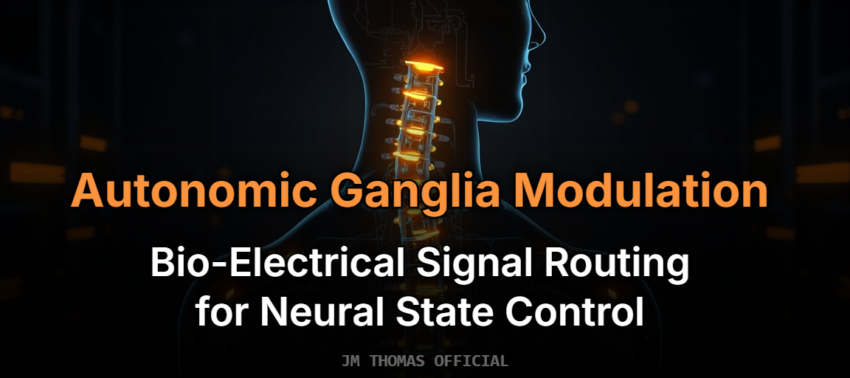
You cannot run high-voltage consciousness on a degraded nervous system. Reality engineering is not a metaphysical abstraction; it is an applied engineering discipline operating on precise biological hardware. To alter observational output within a physical local framework, the biological substrate must maintain structural and electrical integrity. Most practitioners fail because their nervous system operates in a perpetual state of baseline noise, leaking potential across uncalibrated pathways.
The Biological Architecture of Signal Processing
The human body functions as a complex network of frequency transducers. Primary among these bio-electrical hubs are the RAS Filtering networks and the seven primary Autonomic Ganglia Plexuses distributed along the spinal axis. These nodal centers manage autonomic feedback loops, voltage distribution, and signal routing between peripheral sensation and central computational architecture.
When an operator attempts to project intent without grounding the peripheral system, voltage collapses. The nervous system prioritizes immediate homeostatic survival over high-bandwidth signal generation. Optimization requires deliberate tuning of autonomic tone, shifting the biological receiver from survival reactivity to coherent signal output.

Microtubular Coherence and Probability Collapse
At the sub-cellular level, consciousness interacts with quantum state structures inside neuronal microtubular networks. As detailed in research surrounding Orch-OR theory, quantum coherence within these tubulin polymers enables processing speeds and informational integration far exceeding classical synaptic delay models.
Maintaining quantum state coherence requires a high signal-to-noise ratio in the surrounding liquid-crystal matrix. When chronic stress disrupts cell membrane potentials, the emission of ultra-weak Bio-Photons degrades into erratic noise. The cellular array loses phase synchronization, collapsing the operational field required for external influence.
Transduction via Crystalline Neural Structures
To establish a clean link between cognitive input and biological transmission, the system utilizes specialized crystalline structures within the brain. Pressure-induced mechanical stress in calcite micro-crystals housed within central neural structures generates actionable electromagnetic potential through Pineal Piezoelectricity.

p>This piezoelectric activity acts as a frequency multiplier. By converting mechanical acoustic pressure from structured respiration and internal biomechanical tension into precise electromagnetic output, the central axis becomes a transmitter rather than a passive receiver.
Execution Protocol: Hardware Optimization
Systemic calibration demands systematic execution. To optimize your biological transmitter for operational reality engineering, execute the following hardware protocol:
- Phase 1: Autonomic De-excitation. Normalize vagal tone to reduce ambient systemic resistance. Down-regulate baseline noise across all Autonomic Ganglia Plexuses using rhythmic diaphragmatic braking.
- Phase 2: Peripheral Signal Gating. Calibrate RAS Filtering mechanics by restricting irrelevant sensory inputs during tuning windows.
- Phase 3: Piezoelectric Activation. Engage coherent intracranial pressure vectors to trigger Pineal Piezoelectricity, establishing a unified electromagnetic driver across central nervous pathways.
Mastery over physical variables requires absolute command of your underlying hardware architecture. Access the full scientific blueprints and operational codices inside The Library of Biological Wizardry.
Your nervous system has a brake pedal. Protocol 01 is seven minutes of pressing it.
Four counts in, eight counts out, a before/after number. Free, in your browser, nothing to believe.
Run Protocol 01 free →