110 Hz · left temple · archaeoacoustics
A 110 Hz tone quieted the left temple.
You wanted the 110 tone to quiet the left temple after a neighbor note already sat in the speaker.
A 110 Hz tone is a sound that repeats 110 times a second. Hz is how many times a sound repeats each second. The left temple, also called the left temporal, is T3 and T5, the EEG spots above the left ear. EEG is the strip that records brain waves. Theta cordance is a theta-wave score on the EEG. Archaeoacoustics is the study of sound in old stone rooms. Newgrange is a stone chamber that Jahn printed at 110. Prefrontal asymmetry is how the front left and right sides compared. Time and Mind is the journal. A neighbor note is a nearby tone they played in the same speaker.
What is 110 Hz?
People play a sound that repeats 110 times a second when they want the left temple to quiet, and that count is 110 hertz. Hertz is how many times a sound repeats each second, so 110 means that sound shakes 110 times in one second.
People already play this tone. You wanted the 110 tone to quiet the left temple after a neighbor note already sat in the speaker, so keep the 110 name.
What is the left temple?
T3 and T5 are the EEG spots above the left ear, and people call those spots the left temple or the left temporal. EEG is the strip that records brain waves on that side.
If you came here because you want that side to quiet, stay with 110.
What is theta cordance?
They take a theta-wave score on the EEG and they call that theta cordance. They used the clean 20-to-30-second stretch, and they scored theta from 4 to 8 hertz.
A lower score on the left temple at 110 is the quiet you came here for. Keep the 110 name.
Did a 110 Hz tone quiet the left temple?
Cook, with Pajot and Leuchter, published this paper in 2008 in Time and Mind. Time and Mind is the journal. You can read the paper at doi.org/10.2752/175169608783489099.
The title of the paper is “Ancient architectural acoustic resonance patterns and regional brain activity.” It also carries DOI 10.2752/175169608783489099.
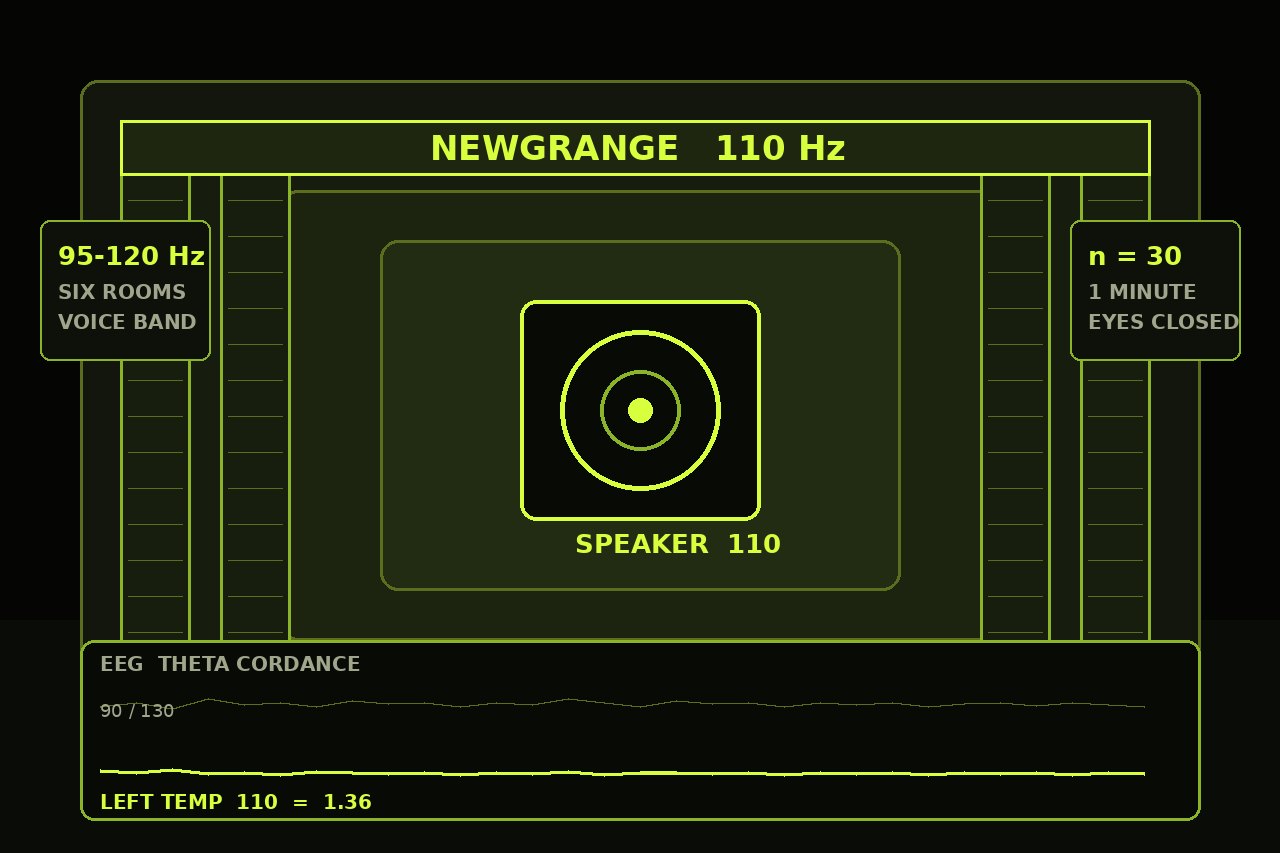
They enrolled 30 people in a first small test they called a pilot, and those people included sixteen women and fourteen men with a mean age of 78.6 years. The SD, which is the spread around that mean age, was 6.3. Twenty-eight people were right-handed.
They played five tones from 90 to 130 hertz for about one minute each, mixed which tone came first, and asked people to keep their eyes closed while they listened. They put speakers near the ears and let people set the loudness themselves so the 110 tone, and the neighbor notes around it, felt loud but still comfortable.
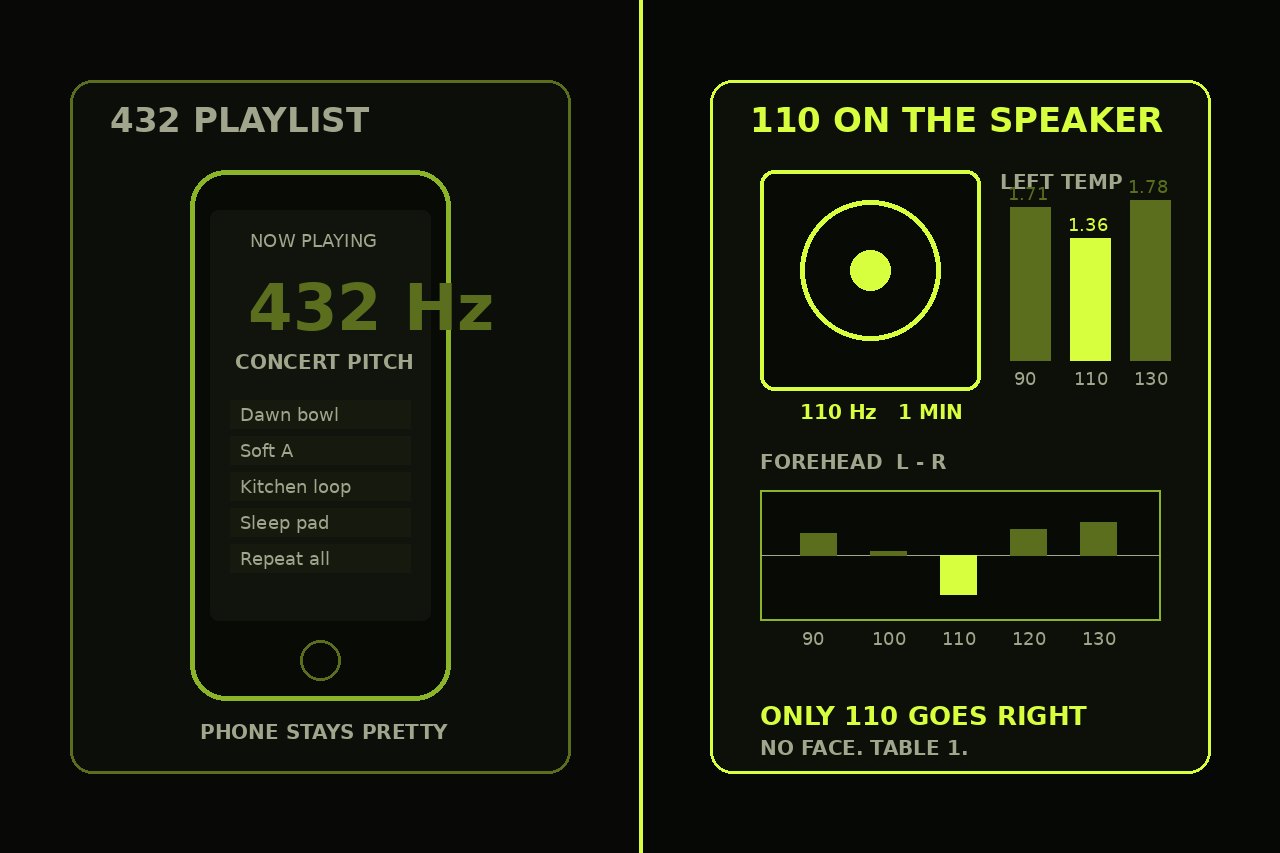
On the left temple the 110 hertz tone scored 1.36 with a 1.27 spread. The 90 hertz tone scored 1.71 with a 1.37 spread, and that gap was p=.04. The 130 hertz tone scored 1.78 with a 1.34 spread, and that gap was p=.01. A p value tells you how often a gap this big would show up if the tones were the same.
The 100 hertz tone scored 1.69 with p=.07, and the 120 hertz tone scored 1.45 with p=.31.
Keep wanting the 110 tone to quiet the left temple.
Did Cook use a stone chamber?
Cook ran this with lab speakers. People heard the tones from speakers near the ears, so they did not walk into a stone room for this score. A passage tomb is a long stone room, the kind of chamber Jahn printed.
Jahn, with Devereux and Ibison, printed earlier different work in JASA in 1996 that put chambers from 95 to 120 hertz on the page and put Newgrange at 110. JASA is the journal for that earlier work. Archaeoacoustics studies sound in old stone rooms.
You can keep wanting the 110 tone. Jahn printed the chamber number first.
What is Newgrange?
Jahn printed Newgrange at 110, and people already care about that stone room when they want this tone. His earlier different work also printed chambers from 95 to 120 hertz.
Keep the 110 name if that stone room is why you came.
What is prefrontal asymmetry?
They compared how the front left and right sides lined up, and they call that prefrontal asymmetry. At 110 hertz they printed that score at -0.18.
They did not collect a thought diary. You can still want the 110 tone to quiet the left temple.
Can you still want the 110 tone to quiet the left temple?
You can still want a 110 tone to quiet that side. People already play it.
People also play 432 on a phone, which is another tone people already use. Stay with 110 if the left temple is why you opened this.
The left temple scored 1.36 at 110 and 1.71 at 90. Cook ran the score with lab speakers.
If you feel unusual distress or you need care, talk to a clinician, because this page is educational and not a diagnosis.
If you want a page about pills labeled placebo that people still took, open the placebo page.
Can you still want the 110 tone to quiet the left temple?
You wanted the 110 tone to quiet the left temple after a neighbor note already sat in the speaker. Keep the 110 name.
The left temple scored 1.36 at 110 and 1.71 at 90. Cook used lab speakers, not a passage tomb. You can still want the 110 tone to quiet the left temple.
Sources
Cook I.A., Pajot S.K., Leuchter A.F. “Ancient architectural acoustic resonance patterns and regional brain activity.” Time and Mind 2008;1(1):95-104. DOI 10.2752/175169608783489099. Pilot, n=30 (16 women, 14 men), mean age 78.6 (SD 6.3), 28 right-handed. Tones 90, 100, 110, 120, 130 Hz, about 1 minute each, random order, eyes closed. Speakers near the ears, self-set loud-but-comfortable. Theta cordance 4-8 Hz from 20-30 s clean EEG. Left temporal (T3, T5) 110 Hz 1.36 (1.27) vs 90 Hz 1.71 (1.37) p=.04 vs 130 Hz 1.78 (1.34) p=.01. 100 Hz 1.69 p=.07 and 120 Hz 1.45 p=.31. Prefrontal asymmetry flip (110 Hz -0.18). No thought diary. Cook ran the EEG with lab speakers rather than a passage tomb. doi.org/10.2752/175169608783489099
Jahn R.G., Devereux P., Ibison M. JASA 1996. Earlier different work. Printed 95-120 Hz chambers and Newgrange at 110.